
The short version, cheapest first
| Software | Built for | Based in | From |
|---|---|---|---|
| xRouten | Small teams, EU data residency, tight budget | Germany | €25/month flat (≈ $28) |
| AntsRoute | Growing teams in Europe | France | €34/month per route (≈ $38) |
| Routific | Strong optimization, international teams | Canada | $0/month up to 100 stops |
| OptimoRoute | Field service, multi-day routes | USA | ≈ $34/month per driver |
| Track-POD | Delivery proof | Latvia | €49/month per driver (≈ $54) |
| Portatour | Field sales with a fixed customer list | Austria | €79.95/month per user (≈ $88) |
| Spoke Dispatch | Couriers, high order volume | UK | ≈ $125/month for 1,000 stops |
Fleet management systems and tools that are mostly GPS tracking or time tracking were deliberately left out. This is about genuine route planning and optimization.
Prices as published in September 2026. Euro figures are the providers' own list prices; dollar figures are approximate conversions.
Plenty of small businesses still plan routes by hand with a spreadsheet and Google Maps. That works up to a point. But as soon as you add a second driver, stops that change daily, or time windows, manual planning runs out of road fast. Route sheets get unwieldy, vehicles are loaded unevenly, and efficiency drops.
Real route planning software solves exactly that. It calculates optimal routes automatically, distributes addresses intelligently across drivers and vehicles, and saves time, fuel and money doing it.
This article compares the main route planning options for small and mid-sized businesses. Only tools with genuine route optimization made the list — not ones that just draw a map. Each one also has to let you sign up and test it yourself, without talking to a salesperson first.
1. How the list was picked
There are a lot of products with "route planning" in the name. Only tools meeting these criteria are in this comparison:
- Real route optimization: not just a map, but automatic calculation of the best order for all your stops — a VRP algorithm. The software has to be able to distribute several stops efficiently across drivers and vehicles, respecting time windows and capacities.
- Self-service signup: no "contact our sales team". You can register yourself and test it free.
- Transparent pricing: prices published on the website. No "price on request".
- A modern interface: simple onboarding, help articles, short learning curve with no training required.
- Integrations and an API: can connect to Shopify, WooCommerce, CRM and ERP systems or other tools, so that orders come in automatically and can be sent back out.
- A sensible price: suitable for a small team on a modest budget. Cutting costs is, after all, one of the main reasons to use route planning software in the first place.
What was deliberately excluded
Fleet management and GPS tracking systems, pure mileage-log tools, and enterprise solutions with no public pricing. These either lack a real optimization algorithm or simply are not aimed at small businesses. Many of them show up in comparison portals and ads, but they offer route planning only as a very basic extra that does not go beyond what free tools like RouteXL or Google My Maps already do.
2. Quick comparison
| Tool | From | Billed | API |
|---|---|---|---|
| xRouten | €25/month (planning) + €10/month per driver (app) | Flat + per driver app | ✔ |
| OptimoRoute | ≈ $34/month | Per driver | ✔ |
| AntsRoute | €34/month | Per driver | ✔ |
| Track-POD | €49/month | Per driver | ✔ |
| Routific | $0 up to 100 stops, then ≈ $150 to 1,000 stops | Per stop | ✔ |
| Portatour | €79.95/month | Per user | From 2 users |
| Spoke Dispatch | ≈ $125/month | Per stop | ✔ |
On billing models: with xRouten you pay €25 a month for unlimited route planning, no matter how many routes or addresses you plan. The mobile app for drivers — navigation, documentation and live tracking — costs another €10 per driver per month. For an operation where not every driver needs the app every day, that works out considerably cheaper than the alternatives.
Routific and Spoke Dispatch bill per stop rather than per driver. Routific's first 200 stops a month are free, after which the price climbs to around $150 for up to 1,000 stops. Spoke Dispatch starts at around $125 for up to 1,000 stops and rises with volume. If you have a lot of daily stops, do the arithmetic on that model before you commit.
Several providers have cheaper entry tiers that are not in the table. Those usually have limited or no proof of delivery — photos, signatures — and no API access. If you need to document stops or connect the software to other systems, you generally need the next tier up, and a considerably higher monthly price.
3. The tools in detail
xRouten: from €25/month
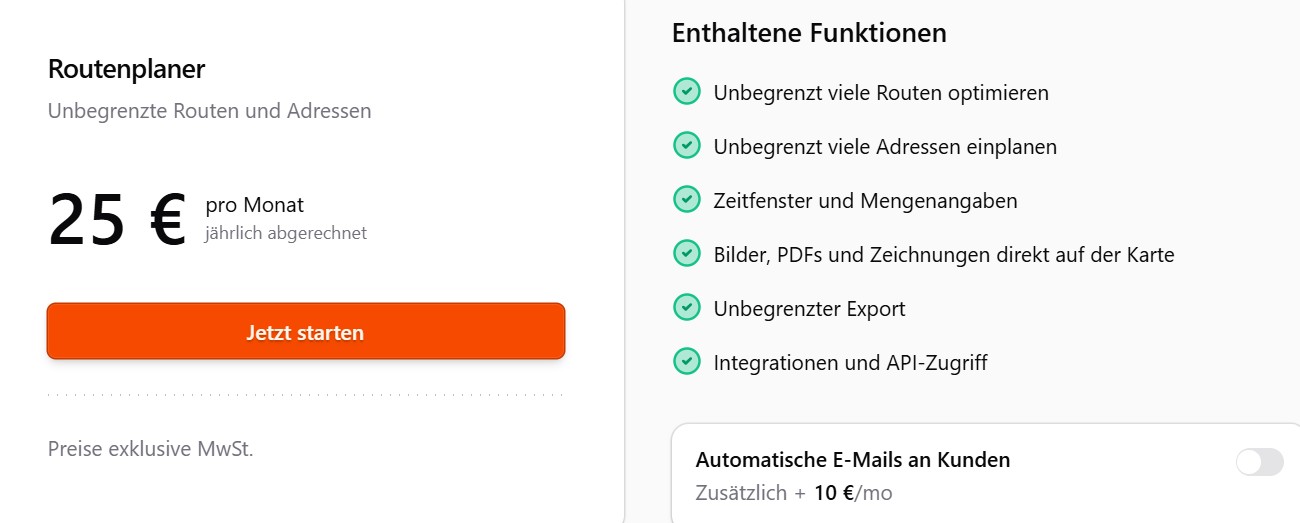
xRouten is a German route planning product built for delivery and service operations. Planning happens on a computer: orders are imported, time windows and vehicle capacities are taken into account, and the software calculates optimized routes for every driver. Drivers then use the mobile app for navigation, order confirmation and digital documentation — signatures and photos.
The base plan for unlimited route planning is €25 a month billed annually. The driver app with live tracking, proof of delivery and checklists is another €10 per driver per month. Where planning is centralized and not every driver needs the app daily, that comes out well below the competition.
Pros:
- Cheapest entry price of everything compared here
- Unlimited routes and addresses on the base plan — no billing per stop or per route
- German company, German-language support
- GDPR-compliant, servers in Germany
- Live GPS tracking and digital documentation included
- API and integrations for CRM, shop systems and other tools
Cons:
- No multi-day routes
- Planning is desktop-browser only, not in the mobile app. The app is for driving and documenting.
AntsRoute: from €34/month per driver
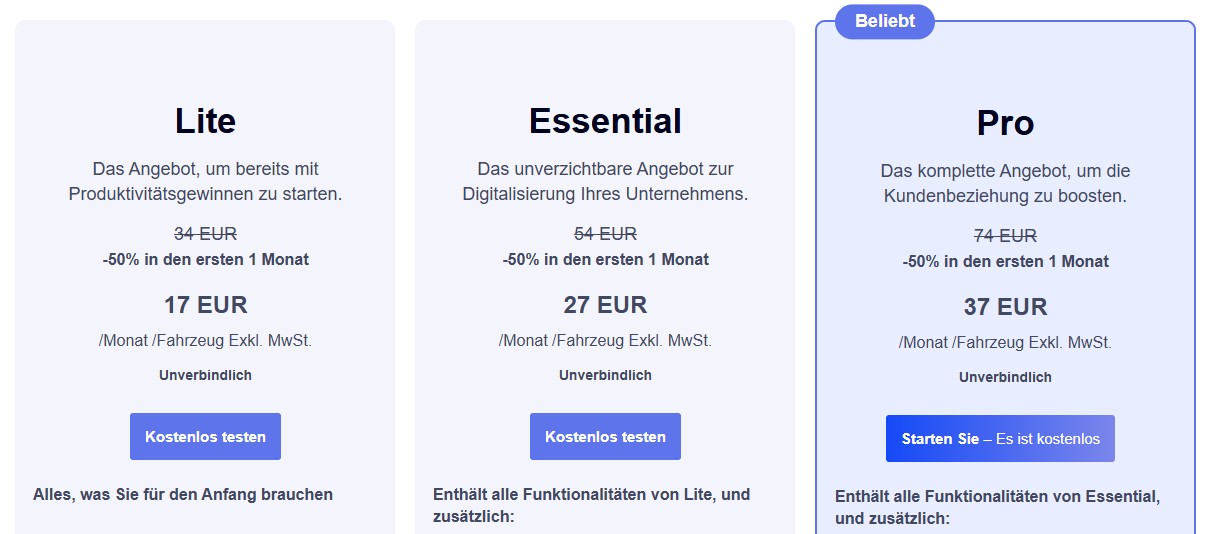
AntsRoute comes out of France and has established itself well across Europe. It does automatic route optimization, has a driver app, and sends automatic customer notifications — a text with an arrival window, for instance. Planned routes are quick to adjust when orders change at short notice. Support runs in English and French.
Pros:
- Intuitive interface, quick to build route plans
- Automatic customer messages, which customers like
- GDPR-compliant, EU servers
Cons:
- To plan several routes you have to buy several seats, even if the mobile app is not used
- The entry price of €34 per driver per month does not include everything. The next tier up (€54 per driver per month) puts it among the more expensive starting points in this comparison.
- No German-language support
Routific: free to 100 stops, then from around $150/month
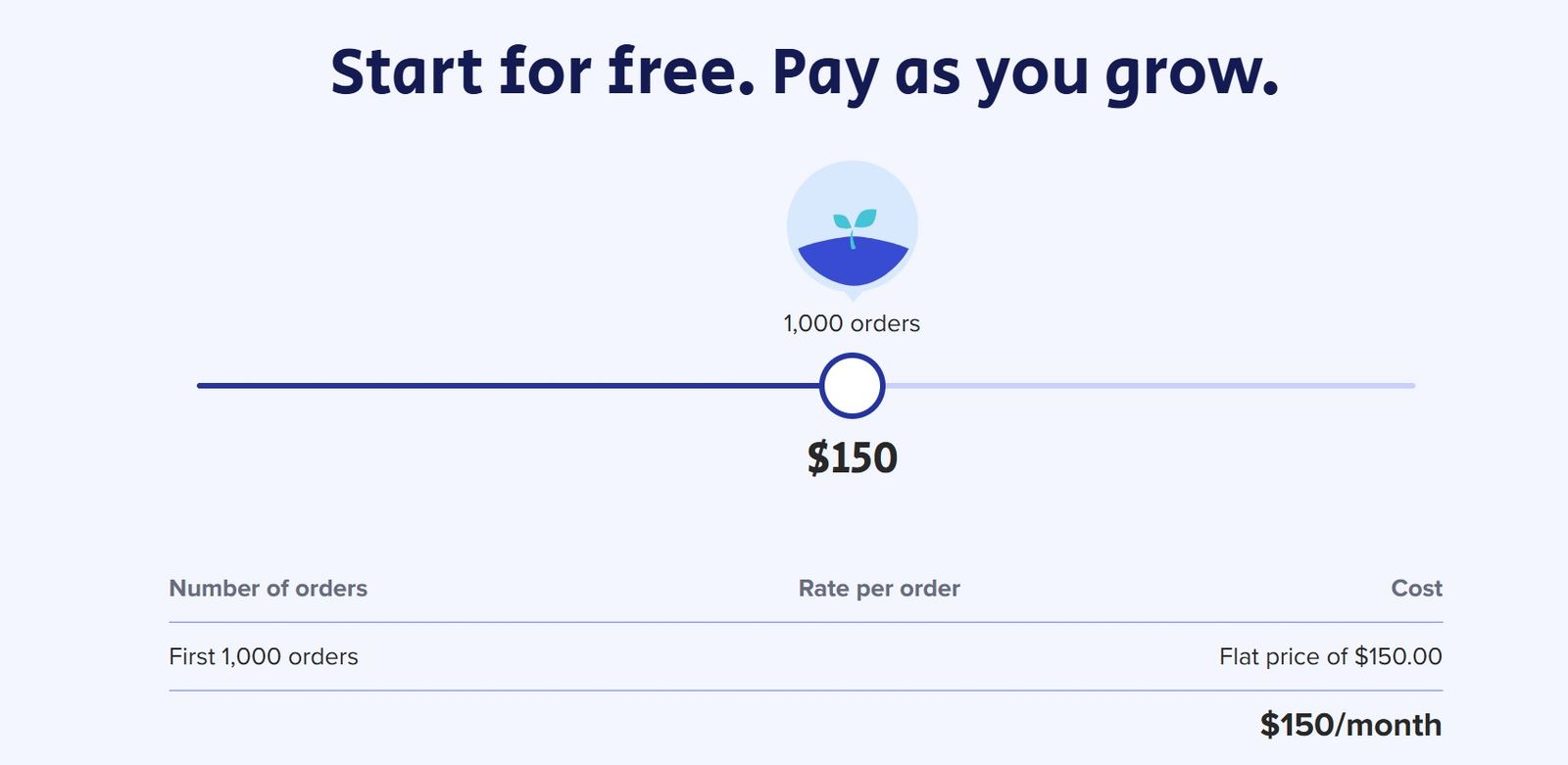
Routific is one of the best-known route planners anywhere. The product is mature, the interface is clean, and its optimizer is regarded as one of the fastest on the market. The pricing is unusual: up to 100 stops a month, Routific is free. Above that you pay around $150 a month for up to 1,000 stops. If you have high volume, work the numbers carefully.
Pros:
- Free up to 100 stops
- Very good optimization algorithm
- Strong API documentation
- No extra driver seats charged for planning several routes — only the number of addresses matters
Cons:
- Sharp jump in price past 100 stops
- Support in English only
- No guaranteed GDPR compliance — servers in the US and Canada
OptimoRoute: from around $34/month per driver
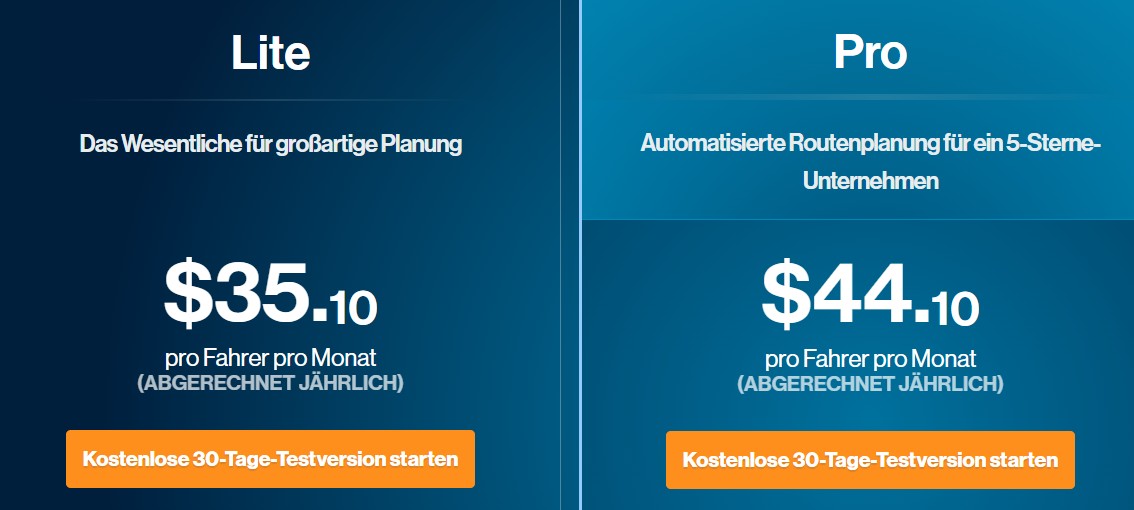
OptimoRoute offers a good feature set at one of the lowest price points among the US providers. It is particularly popular with service businesses that plan field visits alongside deliveries. Recurring routes and multi-day routes are possible, which sets OptimoRoute apart from several competitors and makes its optimization suitable for more complex requirements.
Pros:
- Multi-day and recurring routes (on the more expensive plan)
- Broad feature set across several industries
- Customer feedback can be collected in the app
Cons:
- You have to buy multiple driver seats to plan multiple routes
- Users report routing inaccuracies stacking up on routes over 100 stops
- Limited flexibility once a route is underway
Track-POD: from €49/month per driver
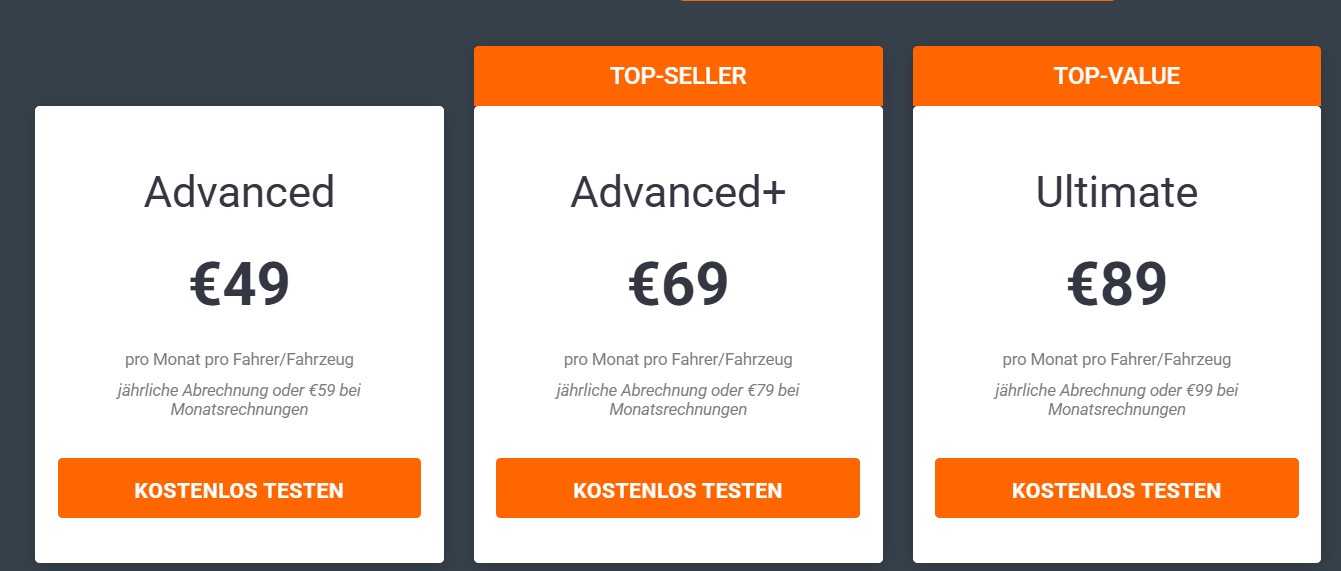
Track-POD's focus is digital proof of delivery: signatures, photos, barcodes. Route optimization is there but less developed than at the specialists. If documenting every delivery is the thing that matters most, Track-POD is worth a look. At €49 per driver per month it sits at the upper end of this comparison.
Pros:
- Strong proof-of-delivery features
- Barcode scanner in the app
Cons:
- You have to buy multiple driver seats to plan multiple routes
- Relatively high price per driver
- No obvious GDPR focus
Portatour: from €79.95/month per user
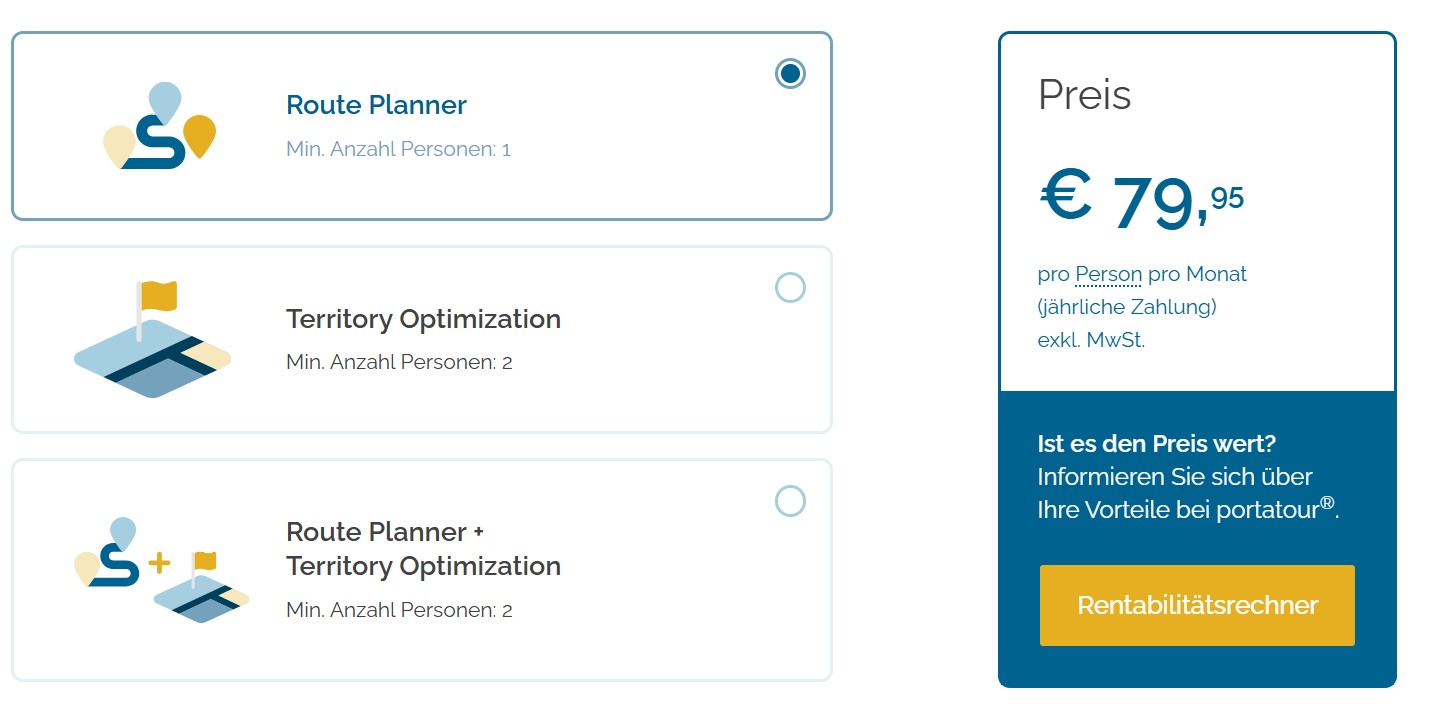
Portatour is the odd one out here. It is built solely for field sales reps who visit a fixed set of customers on a cycle — sales, medical reps and similar. Its automatic planning is based on visit intervals and CRM priorities, not on variable orders.
If you deliver goods or plan service calls to changing addresses, Portatour is the wrong tool. There is no support for changing stop sequences or proof of delivery, both of which matter for delivery and courier work. API access also requires at least two users, so a single licence rules it out.
Pros:
- Very good for field sales with a fixed customer base
- CRM integration for strategic visit planning
- Calendar integrations
Cons:
- Not suitable for deliveries or variable service calls
- No proof of delivery
- Most expensive product in this comparison
- API only from two users up
Spoke Dispatch: from around $125/month
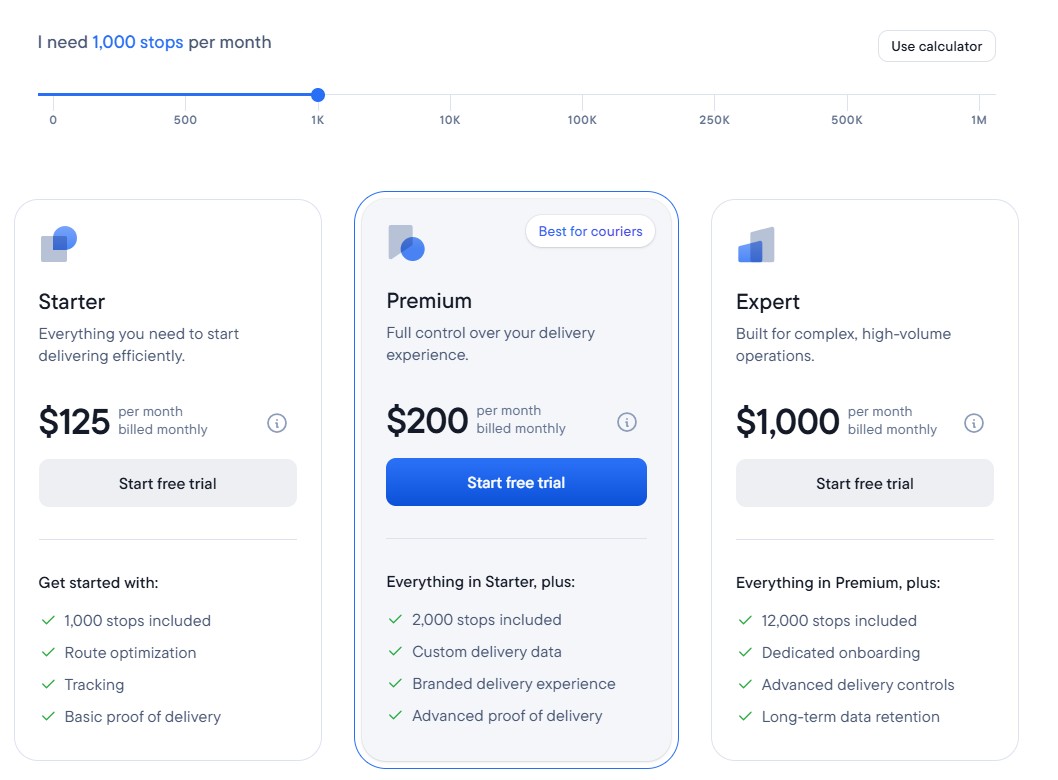
Spoke Dispatch is a capable dispatch system with route optimization built in, used mostly by professional courier and same-day delivery operations. Real-time optimization of routes already underway, and the dispatcher interface, are both at a high level. Billing is volume-based like Routific: up to 1,000 stops a month starts at around $125 and rises with order volume. In return you can add unlimited drivers without paying per seat.
Pros:
- Real-time dispatch and intelligent route optimization
- Customer order portal, where orders come straight in and get scheduled
- Professional courier features
- Very good mobile app
Cons:
- Price climbs with order volume
- High entry price
- No GDPR guarantee
4. Price comparison with several drivers
Price is often the deciding factor for a small business. Here is a direct comparison for teams of different sizes, all using planning, the mobile app and documentation:
| Tool | 1 driver | 3 drivers | 5 drivers | Model |
|---|---|---|---|---|
| xRouten | €25 | €55 | €75 | Flat + driver app |
| OptimoRoute | ≈ $38 | ≈ $114 | ≈ $190 | Per driver |
| AntsRoute | €54 | €162 | €270 | Per driver |
| Track-POD | €69 | €207 | €345 | Per driver |
| Routific | $0 (to 100 stops) | ≈ $150 | ≈ $220 | Per stop |
| Portatour | €79.95 | €239.85 | €399.75 | Per user |
| Spoke Dispatch | ≈ $125 | ≈ $190 | ≈ $270 | Per stop |
All prices excluding tax. Routific and Spoke Dispatch bill per address, so their price does not depend on driver count.
From three drivers up, the difference between per-driver models becomes substantial. You pay for every driver in the fleet, even one who uses the app occasionally or not at all.
5. What bad route planning actually costs
Most businesses underestimate what inefficient routes cost them. A concrete example:
A delivery operation with 3 drivers and 25 stops a day drives on average 15 to 20 percent more miles than it needs to without optimization. At a typical 50 miles per driver per day, 18 miles per gallon and $3.60 a gallon, over 220 working days that adds up to roughly $1,000 to $1,320 a year in extra fuel — from nothing more than a bad stop order.
On top of that:
- More hours per route, both planning and driving, which is wage cost
- Higher vehicle wear and fuel consumption
- Unnecessary emissions, which matter for sustainability reporting and for customers
- Worse punctuality, which customers notice immediately
Route planning software used regularly usually pays for itself within a few weeks. Optimizing routes is not a luxury; it is a direct lever on costs.
6. What to watch when you introduce it
Moving from spreadsheets and Google Maps to route planning software sounds like more work than it is. Most modern tools are built so that you can be planning productively within a day.
- Data preparation is the most important step. Before you start, your customer addresses and order data should be clean and complete. Bad addresses are the most common reason the first optimized routes do not come out right.
- Test with real data. Most providers offer a free trial of 7 to 30 days. Use it with routes you actually plan, not sample data. That is the only way to see whether the optimization works in your area and for your kind of work.
- Test how flexible the program is. You cannot always take the algorithm's word for it. You and your colleagues have local knowledge a computer cannot beat. Check how quickly you can move, reorder and adjust stops on the map, with and without optimization.
- Bring your drivers in early. The mobile app is usually the make-or-break point. If drivers understand why the stops are in that order, and the app is easy to use, adoption goes much more smoothly.
- Sort out integrations. If you use an inventory system, an online shop or a CRM, check before buying whether there is a direct integration or whether you will be importing data by hand.
7. Route planning software vs Excel and Google Maps
Excel and Google Maps work up to a point. Here is the difference a real route planner makes:
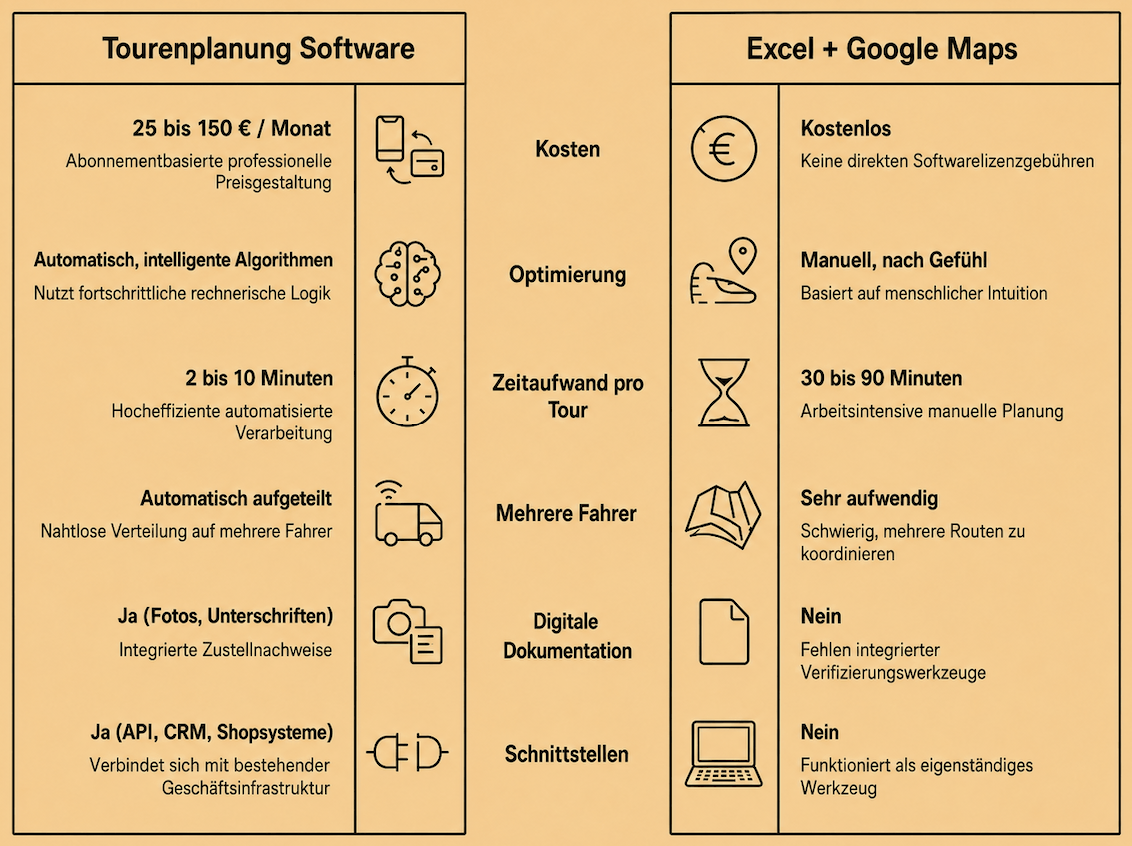
The most obvious difference is time. Planning routes by hand takes 30 to 90 minutes a day at a computer. Route planning software does the same job in 2 to 10 minutes, automatically and with a better result.
Then there are the things that are simply not possible in a spreadsheet. Time windows are barely workable, coordinating several drivers by hand is laborious, and there is no mobile app for the drivers. If you need proof of delivery — photos or signatures as evidence — manual tools hit their limit quickly.
The one genuine advantage of Excel and Google Maps is that they are free. Route planning software costs roughly $30 to $170 a month, which pays for itself quickly once you count the daily hours manual planning takes, plus the extra miles from unoptimized routes.
8. Which industries use route planning software?
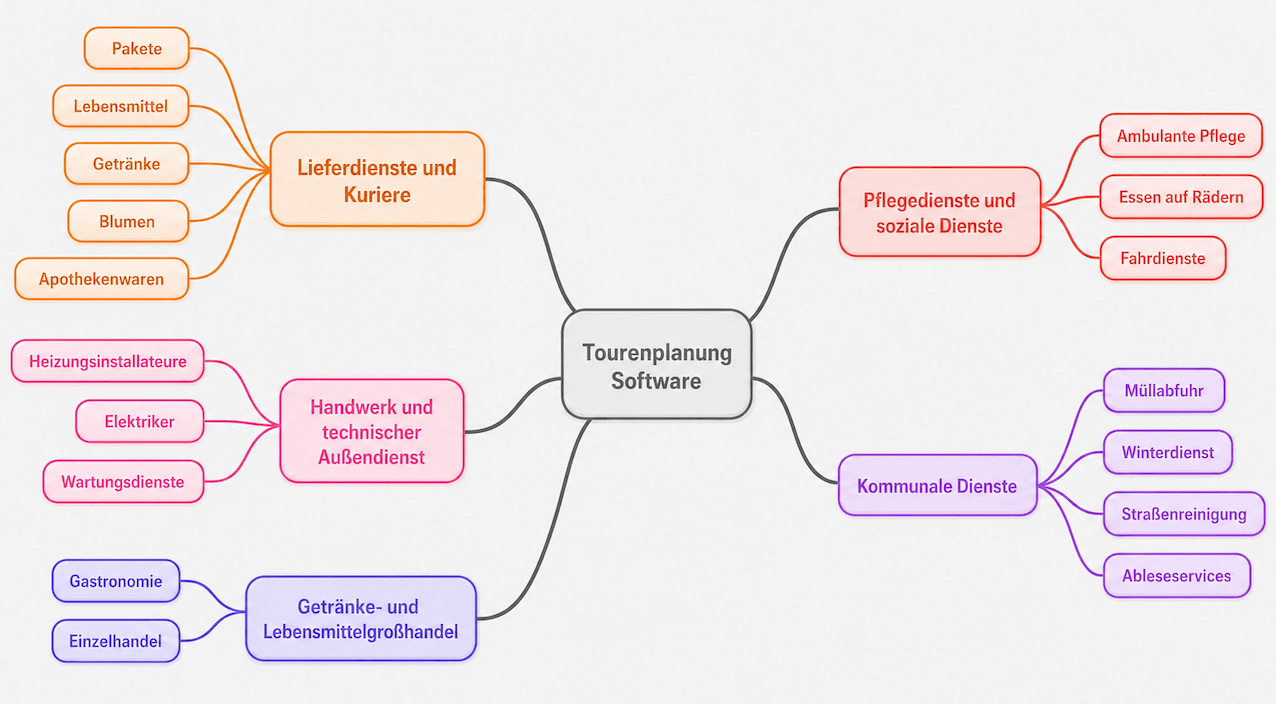
Efficient route planning is not only a topic for large logistics companies. The software is used daily by very different operations:
- Delivery and courier services: parcels, food, drinks, flowers, pharmacy goods. Time windows, vehicle loading and fast automatic planning matter most here.
- Home care and social services: visiting care, Meals on Wheels, patient transport. Often fixed time windows and route plans that change daily.
- Trades and technical field service: HVAC installers, electricians, maintenance crews. Service windows and assigning the right job to the right person are the deciding factors.
- Municipal services: waste collection, snow removal, street sweeping, tree watering. Often a very large number of stops, fixed geographic areas and recurring routes.
- Food and beverage wholesale: regular deliveries to restaurants and retail, usually with capacity limits per vehicle and fixed delivery windows at the customer.
What they share is a lot of addresses, several drivers and vehicles, and planning by hand that simply takes too long.
9. Verdict
There is no single best route planning software. It depends on the use case.
| Use case | Pick | Why |
|---|---|---|
| Small team, EU data residency, lots of addresses and routes | xRouten | Lowest total price, flat rate |
| Booking page for customers wanted | AntsRoute | Solid EU product, good reviews |
| Strong optimization, international teams | Routific | Mature algorithm, wide track record |
| Customer feedback in-app, multi-day routes | OptimoRoute | Broad feature set, cheapest US provider |
| Proof of delivery is the priority | Track-POD | Strong POD features, barcode scanner |
| Field sales, not delivery | Portatour | The only tool built specifically for it |
| Courier work | Spoke Dispatch | Professional dispatch features |
Nearly all of these offer a free trial. Test two or three with your own data and your own routes before deciding. It is usually only in real operation that it becomes clear which one fits your work.
10. Frequently asked questions
Who is route planning software worth it for?
If you drive 10 to 15 stops a day or more, switching almost always pays. Delivery services, couriers, trades, drinks distributors and municipal services all have the same problem: too many addresses, too little time, and manual planning costing valuable minutes every morning. As soon as a second driver appears, spreadsheets and Google Maps get unmanageable.
What does route planning software cost?
It depends heavily on the model. Many providers bill per driver, typically $35 to $55 per driver per month. With three drivers that is $105 to $165 a month. xRouten starts at €25 a month for planning, billed flat, with the driver app at €10 per driver per month.
Is there free route planning software?
Free tools like RouteXL (up to 20 stops) or Google Maps (up to 10 stops) work for very small volumes. Once you plan a lot of stops daily, coordinate several drivers or need time windows and capacities, free tools no longer cover it. Most professional providers also offer a free trial. We compared 8 free route planners with optimization here.
What is a good OptimoRoute alternative?
If you want a European alternative to OptimoRoute, look at xRouten: German interface, German support, GDPR-compliant and billed flat rather than per driver. AntsRoute is another European option with EU servers. There is a full write-up in our article on OptimoRoute alternatives.
Is all route planning software GDPR-compliant?
That depends on the provider. US providers such as Routific and OptimoRoute store data on servers in the US or Canada, which can be a problem for personal data — customer addresses or drivers' GPS data. European providers such as xRouten and AntsRoute run their servers in the EU.
Can route planning software connect to a shop system or ERP?
Most modern route planning systems offer an API or ready-made integrations for Shopify, WooCommerce and other systems, so orders can be transferred automatically into route planning as jobs, and the resulting documentation sent back. Where no ready integration exists, the usual routes are a spreadsheet import or the API. Check this before you buy — it is the difference between a system that saves you an hour a day and one that adds a second data-entry job.
Try xRouten free for 14 days
Try it now