
Quick overview
| Tool | Best for | Data in | From |
|---|---|---|---|
| xRouten | Delivery and service work, flat-rate pricing | Germany | €25/month |
| Routific | Best-in-class optimization | USA/Canada | $0 to 100 stops |
| AntsRoute | Customers booking their own slots | France | €34/month |
| Track-POD | Delivery documentation | Latvia | €49/month |
| Portatour | Field sales, not delivery | Austria | €79.90/month |
| Praxedo | Technician scheduling over days and weeks | France | €35/month |
↓ Detail, strengths, weaknesses and a price comparison below
OptimoRoute is a well-known route planning and optimization product, and for a lot of operations it is a good one. It is technically solid and used worldwide. This article is about the cases where it stops being the right fit, and what the honest alternatives are.
Why operations look for an alternative
1. You pay per driver, even when the app is never opened
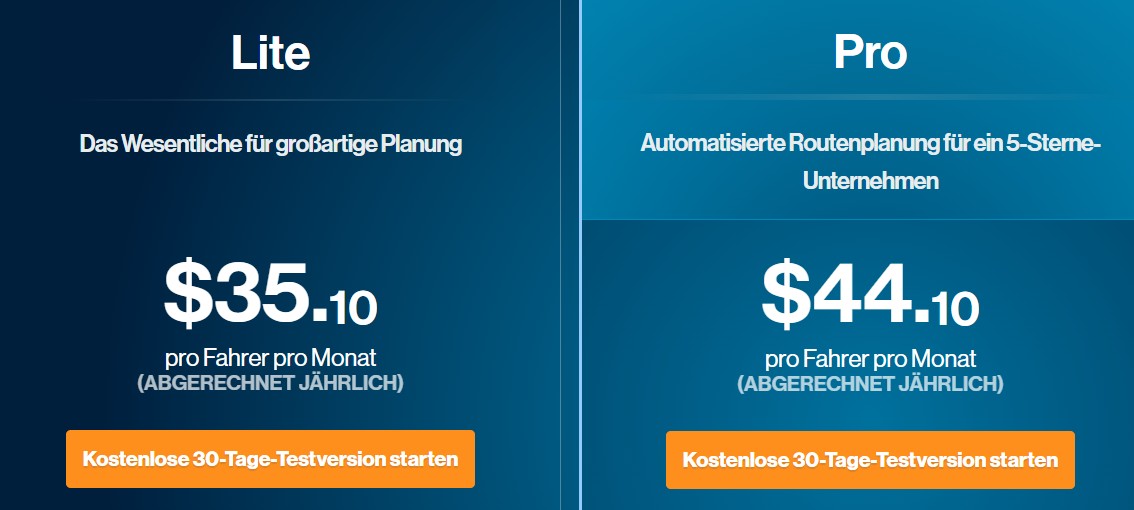
This is the reason that comes up most. OptimoRoute's pricing is based on driver count, and you can only plan as many routes as you have drivers set up. Planning 10 routes to optimize them, compare them, or simply export and print them is expensive under that model.
The entry price is $35 per driver per month, but without proof of delivery. If you need digital proof — photos, signatures and timestamps, which most operations do — you are at $44.10 per driver per month.
If you want to plan several routes in parallel, say five routes for five vehicles, you need five driver seats. Even if the drivers never open the app and the routes go out printed or by phone, you pay for each. That model makes sense for larger fleets where every driver is in the app. For smaller operations with centralized dispatch it can get disproportionately expensive.
2. Routing accuracy on large routes
Users on Capterra and G2 report the same things repeatedly. One Capterra reviewer notes in December 2025 that inaccuracies compound on routes with more than 100 stops and land directly on time and fuel cost. For an operation with a lot of daily stops, that is not a marginal problem.
3. Limited flexibility once a route is underway
Several users criticize how hard it is to adjust a planned route on the road. Adding a stop or changing the order mid-route runs into limits, and real-time ETAs are described as imprecise.
4. Price relative to what you get
On G2, price is a recurring criticism. Several users say the value is not there, and some report that the price has doubled over recent years.
What users consistently praise, in fairness: the desktop interface, described as clear and intuitive. For a new dispatcher doing straightforward route planning without many special cases, getting started is comparatively easy.
5. Where your data lives
OptimoRoute stores data on US servers. For US operations that is a non-issue. For anyone handling EU residents' data it is a live question: after the CJEU's Schrems II ruling in 2020, transfers to the US without additional technical and contractual safeguards are legally exposed. The EU-US Data Privacy Framework (2023) created a new basis but remains contested and could end up back before the court.
If you work with municipal clients in Europe, or have an active data protection officer, this is a concrete procurement question rather than a theoretical one.
What to actually compare on
Pricing structure and how it scales
The model has to fit the operation. Do you pay per driver or per route? What happens when not every driver needs the app? What does a seasonal peak cost you? Is onboarding extra? Is there a minimum term? Are integrations in the base price? A model that scales fairly for a small operation looks different from one optimized for a large fleet.
Depth: optimization only, or documentation too?
The deciding question is often whether route optimization alone is enough, or whether you also need to document what happened on the route. For operations that need proof of delivery, maintenance records or inspection logs, a pure optimizer will not do.
Integrations and API
If you run an inventory system, a CRM or an ERP, you do not want to type everything twice. Can the software pull order data from the system you already have, and write completed documentation back? API access and ready-made integrations matter here.
Language and support
Software used daily has to be in the team's language — the desktop interface, the driver app and support. Good support is reachable by phone without a maze. A lot of providers run ticket systems and canned responses that miss the actual problem. In daily operations you need someone competent who reacts quickly.
Where the data is stored
For European operations this is often not optional. Route planning software processes names, addresses, delivery windows, sometimes phone numbers and contacts — personal data under GDPR. Putting that in a US cloud means being able to justify and document it. Choosing an EU-hosted provider is simpler.
The alternatives
xRouten
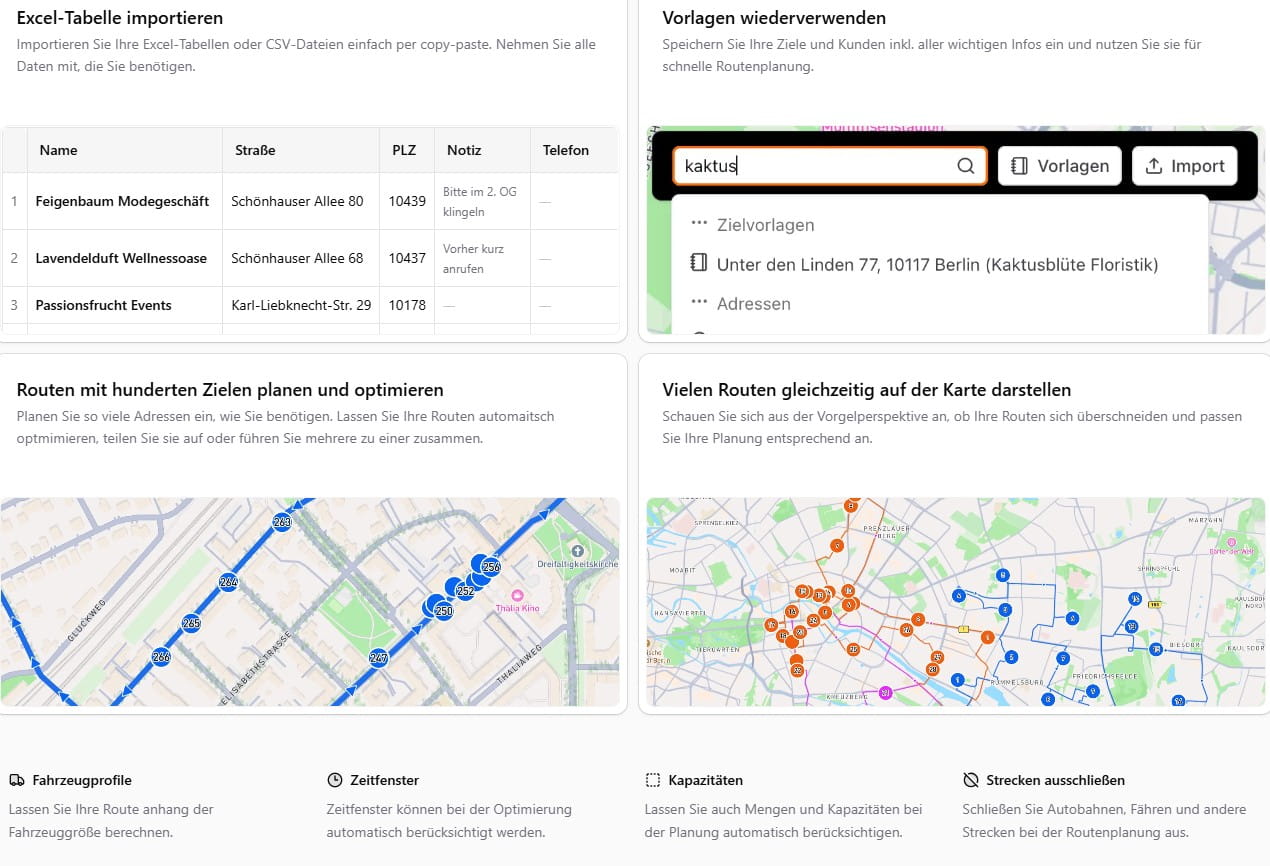
xRouten is a German product covering route planning, optimization, GPS live tracking and digital job documentation. It is aimed at delivery services, couriers, service technicians, trades and municipal operations — anyone planning routes daily who needs more than a spreadsheet and Google Maps, but not enterprise software.
The core difference from OptimoRoute is the billing model. Planning is a flat €25 a month for unlimited routes and unlimited addresses; you are not charged per driver for it. The driver app is a separate module at €10 per driver per month, and you only buy it for the drivers who actually use it.
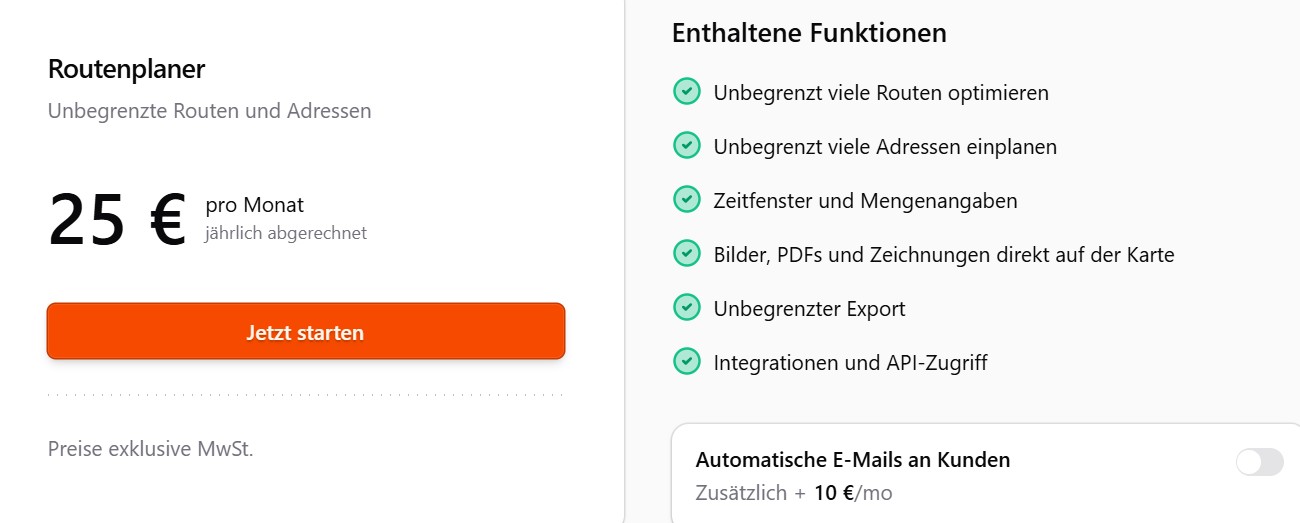
The planning plan includes:
- Unlimited route optimization
- Unlimited addresses
- Time windows and quantities
- Unlimited export
- Integrations and API access
- Images, PDFs and drawings directly on the map
The mobile app includes:
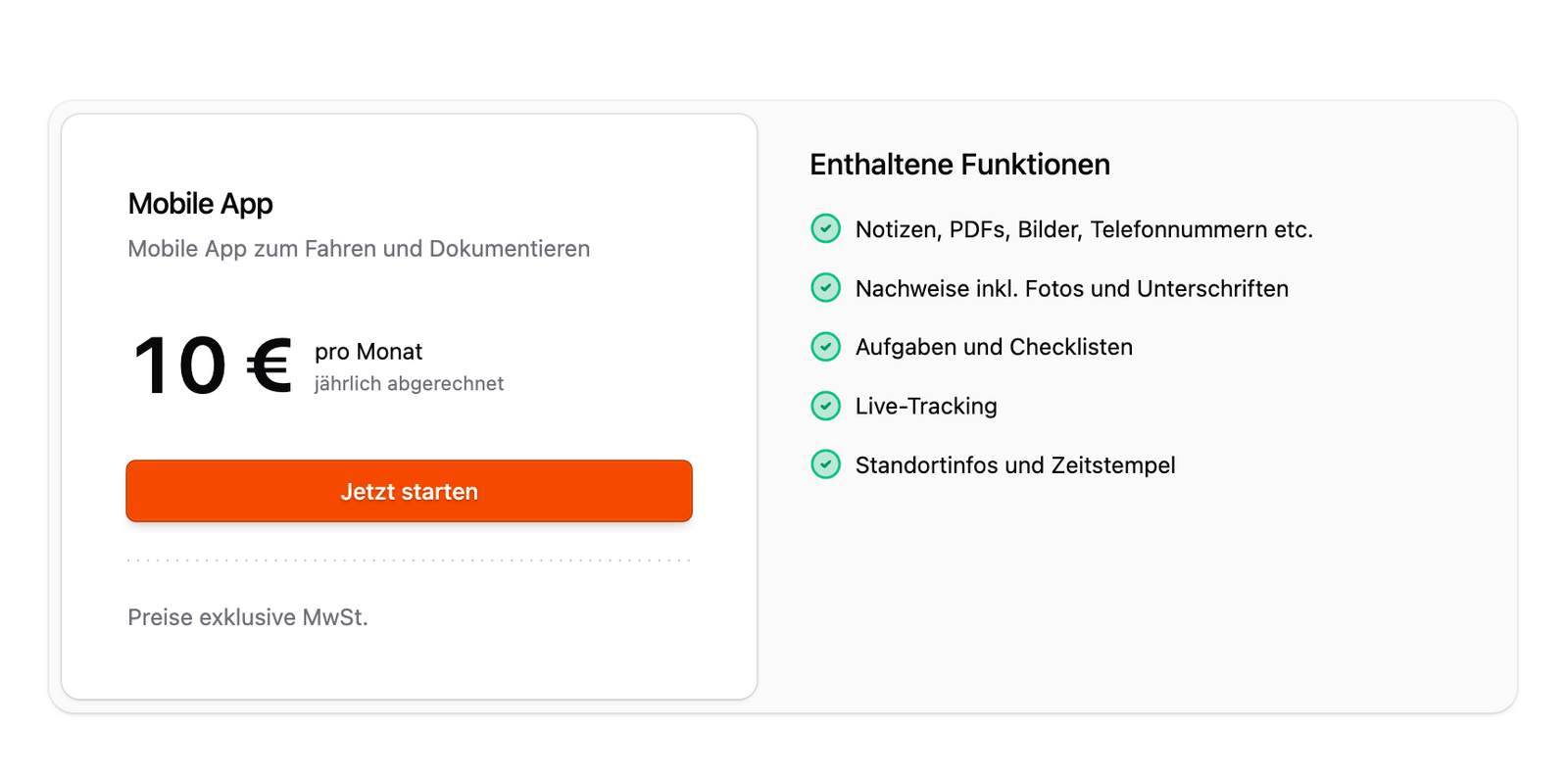
- Navigation: the optimized route shown in the app
- Job documentation: notes, PDFs, images and phone numbers at the stop
- Proof: photos and signatures as digital proof of delivery
- Tasks and checklists: defined tasks ticked off at each stop
- Live tracking: the dispatcher sees where drivers are in real time
- Location and timestamps: every stop documented automatically
- Tracking links to customers: as parcel carriers do
An operation with 5 drivers comes to €75 a month for full route planning, GPS tracking and digital documentation including proof of delivery.
Where xRouten is the wrong choice: no multi-day routing, so if you plan routes that span days, OptimoRoute does that and xRouten does not. No truck-specific routing with tolls or vehicle profiles. No CRM integration for field sales. And the interface and support are in German and English.
Routific
If what you want is the best optimization quality and none of the European angle matters, Routific is the more direct comparison. Free up to 100 stops a month, then around $150 for up to 1,000, with no per-driver seats — only addresses count. English-only support, servers in the US and Canada.
AntsRoute
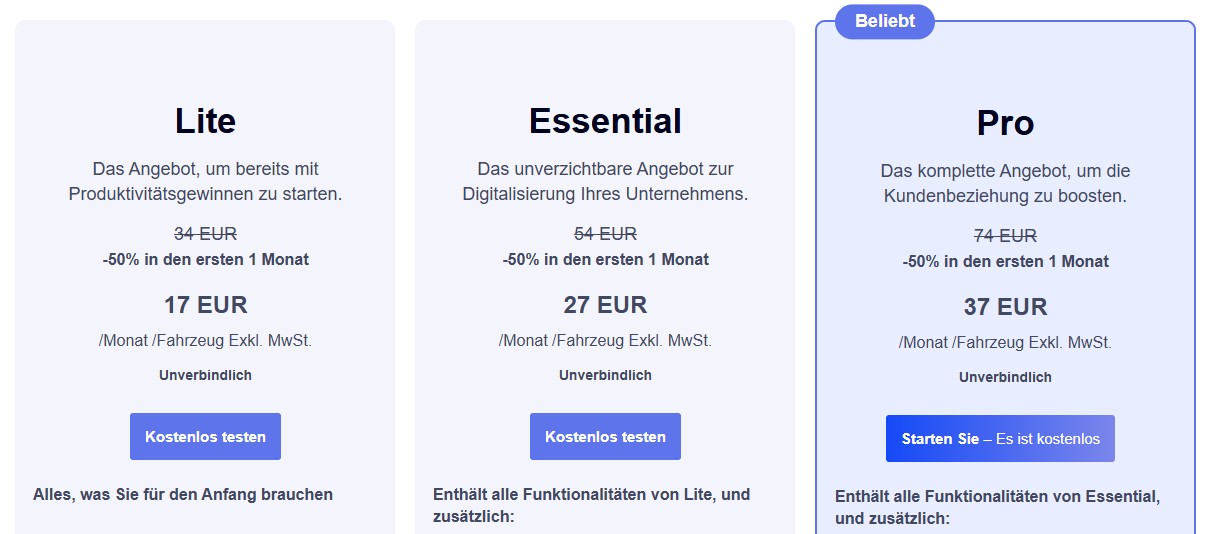
A French company with good European coverage. Route optimization, GPS tracking and delivery documentation, with features OptimoRoute does not have:
- Automatic customer feedback collection on delivery
- Appointment reminders to customers by email
- A booking page for customers, linked to route planning
Price: from €34 a month; with proof of delivery and extended features €54 per person per month. As with OptimoRoute, you pay per driver whether or not the app is used.
Best for: operations that want to offer a booking page for service calls or deliveries.
Track-POD
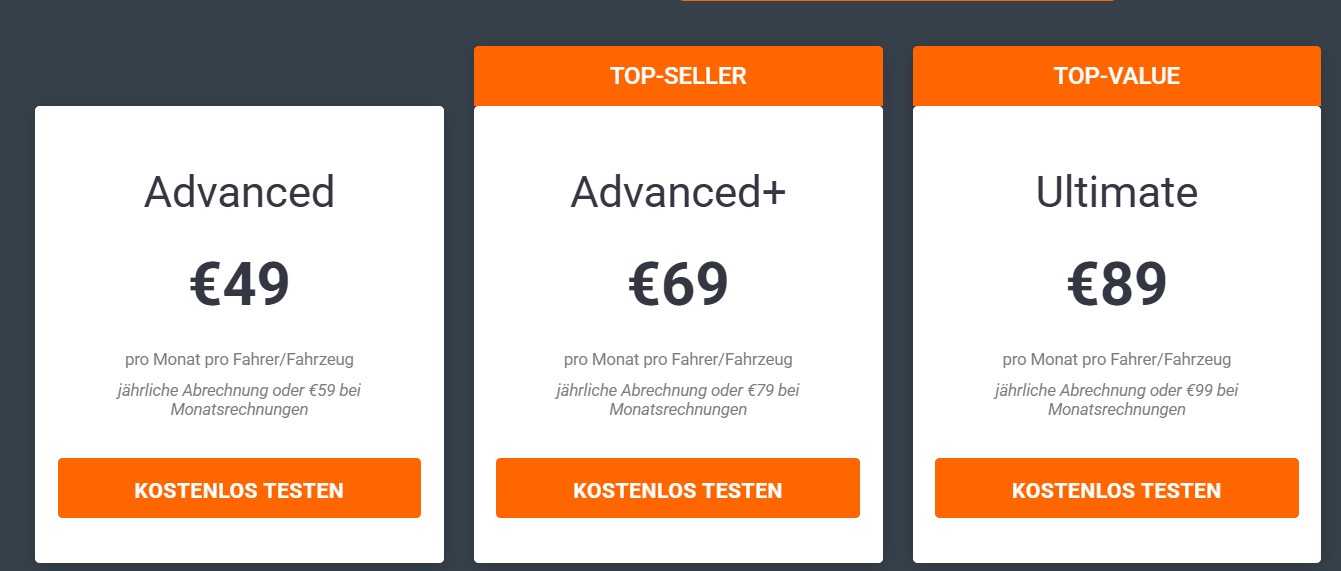
A Latvian company focused on digital proof of delivery. Route optimization exists but is not the point. Things Track-POD does that OptimoRoute does not:
- Drivers record whether and how much cash they took on delivery
- Odometer and fuel level recorded and reported from the app
- Load checked and documented before departure
- Messages sent from the dashboard straight to the driver app
Price: from €49 per person per month, €69 with the extended feature set, billed per driver seat regardless of actual app use. There is also a per-order model: 1,500 orders for €285, about €0.19 an order, cheaper as volume rises.
Best for: operations where vehicle and load documentation matter and the higher price is acceptable — Track-POD is more expensive than OptimoRoute.
Praxedo
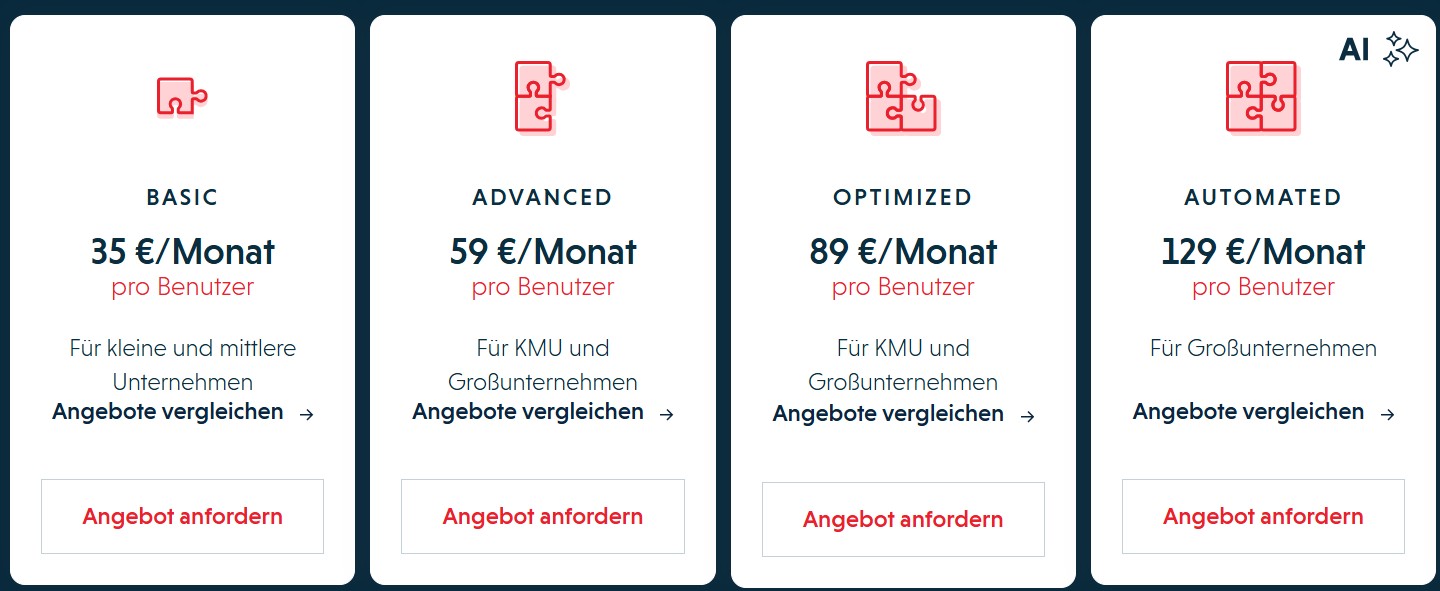
A French field service management system specialized in scheduling technician visits across days and weeks, taking qualifications, service areas and material requirements into account. Less suitable for daily delivery routes with many stops. In exchange you get more project-management capability and a wider range of industry integrations — Sage, Salesforce, SAP.
Price: from €35 per person per month, rising to €129 per seat per month with more modules.
Best for: machinery and plant engineering, elevator maintenance, electrical installation — businesses scheduling complex technician visits on a calendar.
Portatour
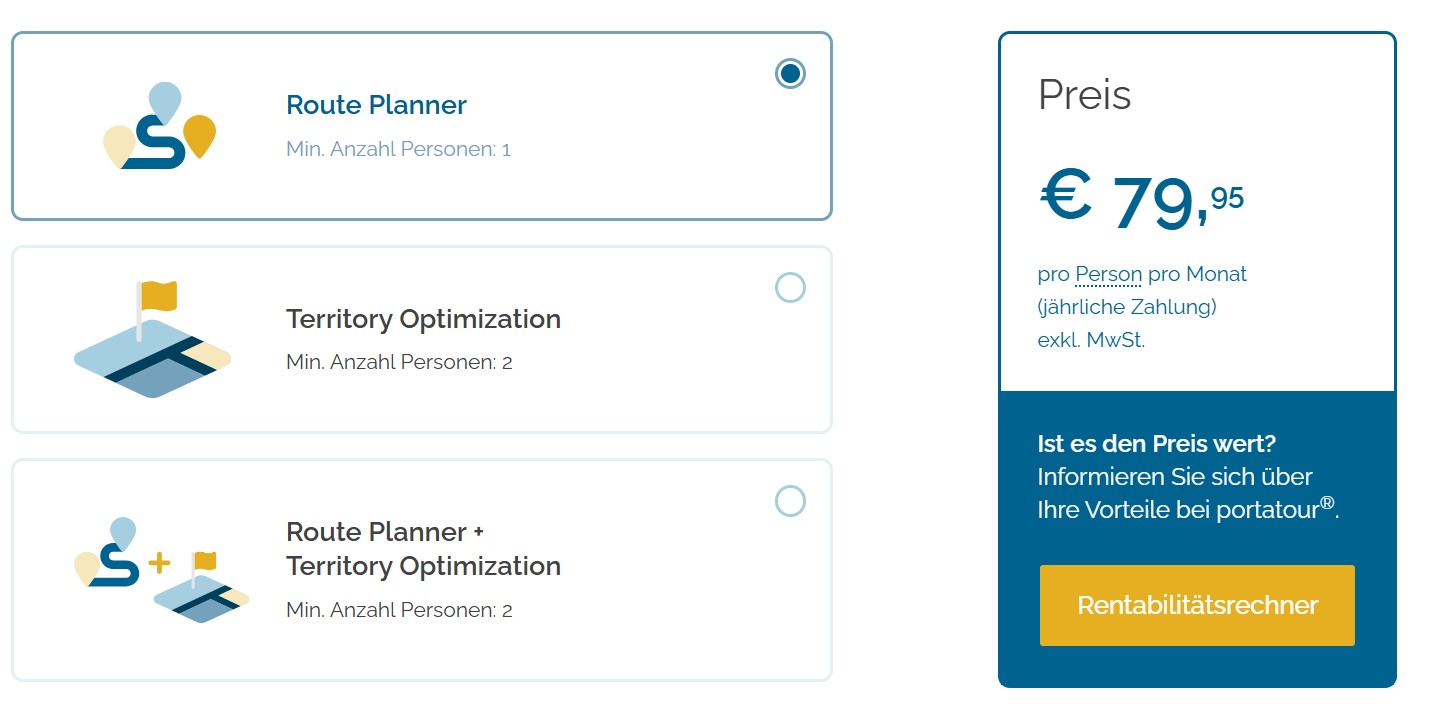
Austrian software for automatic visit planning in field sales. You set how often each customer should be visited and it plans optimized day routes that honor those intervals. A different paradigm from classic route planning: it decides who to visit today out of a pool of customers.
Price: from €79.90 per person per month.
Best for: sales reps, pharmaceutical reps, key account managers — teams planning regular customer visits who deliver nothing and perform no service work.
Not suitable for: GPS tracking, digital delivery documentation, photos and signatures.
The price comparison that matters
The difference most people miss until the invoice arrives. With OptimoRoute you pay per driver whether or not the driver uses the app. Plan five routes, pay for five driver seats: $44.10 each, $220.50 a month, around €200 at current rates.
With xRouten, route planning is a flat €25 a month for unlimited routes. The driver app is added per driver, but only for the ones who need it. For an operation with five drivers that is a saving of roughly €125 a month.
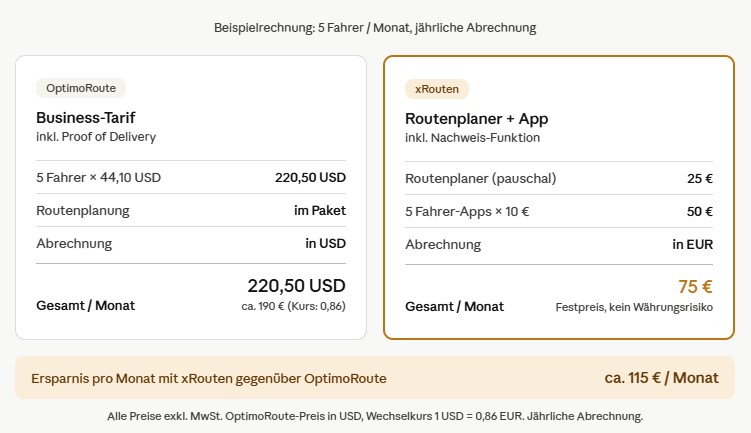
That comparison flips if all five of your drivers use the app daily and you also need multi-day routing — in which case OptimoRoute's feature set is doing work the price difference pays for.
Switching, practically
A software change sounds harder than it is. In practice it runs in three steps.
Step 1: export the data
OptimoRoute exports order data as CSV. Addresses, time windows and customer information are not locked in. Export once, import into the new system.
Step 2: test in parallel with live operations
Run the new tool alongside OptimoRoute with real routes — xRouten offers 14 days. Put one or two drivers on the app in that period and see how they get on. Driver acceptance is what decides whether a switch sticks.
Step 3: switch and onboard
If the trial worked, the switch is straightforward: cancel the old subscription, start the new one, put the drivers on the app.
A realistic timeframe is 1 to 2 weeks, most of it parallel testing. The switch itself is usually a day.
What you keep
Address data, customer lists and historical order data sit with you as CSV exports from OptimoRoute. Export and archive the historical reports before you cancel.
Which one fits
For delivery services, couriers, municipal operations and service providers who want planning, tracking and documentation in one tool at a predictable price, xRouten is the closest match to what OptimoRoute does, minus the per-driver billing.
If optimization quality is the priority and data residency is not, Routific is the stronger technical comparison.
If customers should book their own appointments, AntsRoute has that and OptimoRoute does not.
If documenting every delivery down to the cash taken is the job, Track-POD is built for it.
If you dispatch field sales visits, Portatour. If you schedule technicians across weeks, Praxedo.
And if none of the four reasons at the top of this article apply to you, staying on OptimoRoute is a perfectly reasonable answer.
Frequently asked questions
Is OptimoRoute GDPR-compliant?
OptimoRoute stores data on US servers. After the CJEU's Schrems II ruling, such transfers are legally exposed without additional safeguards. The EU-US Data Privacy Framework (2023) created a new basis but remains contested. For operations with an active data protection officer, or with municipal clients in Europe, server location is a legitimate reason to switch.
What does OptimoRoute cost?
From around $44.10 per driver per month if you want proof of delivery. Planning 5 routes means 5 driver seats, so about $220.50 a month, roughly €200. xRouten by comparison is €25 a month for unlimited route planning plus €10 per driver for the app, so €75 a month for an operation with 5 drivers.
Can all of these be tested free?
Yes. Every product listed here can be tested free for up to 14 days with full access, so you can try it with real routes before deciding. Praxedo requires a sales enquiry first; the others let you register with an email address and password.
Is there a free OptimoRoute alternative?
For occasional or simple route planning there are free tools like RouteXL or Multiroute, and Routific is free up to 100 stops a month. For professional use with optimization, documentation and tracking, the free tiers run out quickly.
How long does switching take?
In practice 1 to 2 weeks, most of it parallel testing. The switch itself can be done in a day: import addresses and orders, put drivers on the app, go.
Which alternative suits a small operation with one driver?
xRouten at €25 a month covers full route planning, GPS tracking and digital documentation for a single-driver delivery operation. It needs no IT knowledge to run.
You might also like

Try xRouten free for 14 days
Try it now