
The short version
- Digital route optimization replaces rigid, hand-maintained routes with planning that is data-based and more flexible.
- Shorter distances and fewer empty miles reduce cost and planning effort while improving vehicle utilization.
- GPS and real-time data make delays and breakdowns visible early enough to adjust the route.
- You do not have to replace your existing ERP. A specialized route planner can be connected to it or run alongside it.
- The options range from full industry suites with telematics and container management to focused route planners. What decides it is what the operation actually needs.
What digital route optimization changes
Full vehicles, tight windows, container locations that move, and rising fuel costs make route planning in waste collection increasingly complex. It stopped being something a spreadsheet and experience could solve on their own. More and more waste operations are turning to digital route optimization to plan routes more efficiently, more transparently and more verifiably.
This article covers why the switch pays, where the biggest obstacles in conventional planning sit, how an implementation runs in practice, and what matters when choosing.
Why it has become unavoidable
Municipal and private waste companies are in a paradoxical position. Requirements grow while resources stay tight. More collection points, denser city centers, stricter emissions requirements and a noticeable shortage of drivers meet an expectation that collections happen reliably and on time.
Conventional route planning is usually built on historically grown routes that are rarely reviewed from the ground up. The result is unnecessary empty running, unevenly loaded vehicles, and a planning effort that starts over with every road closure or sick day. That is what route optimization addresses. It replaces instinct with data and makes routes not only shorter but more robust against everyday disruption.
There is also structural pressure that will increase rather than ease: municipalities have to serve more households and more waste streams on flat or shrinking budgets, while commercial operators increasingly compete on efficiency rather than price per ton. An operation that does not review and adjust its routes loses competitiveness gradually, without it being obvious day to day.
Where conventional planning breaks down
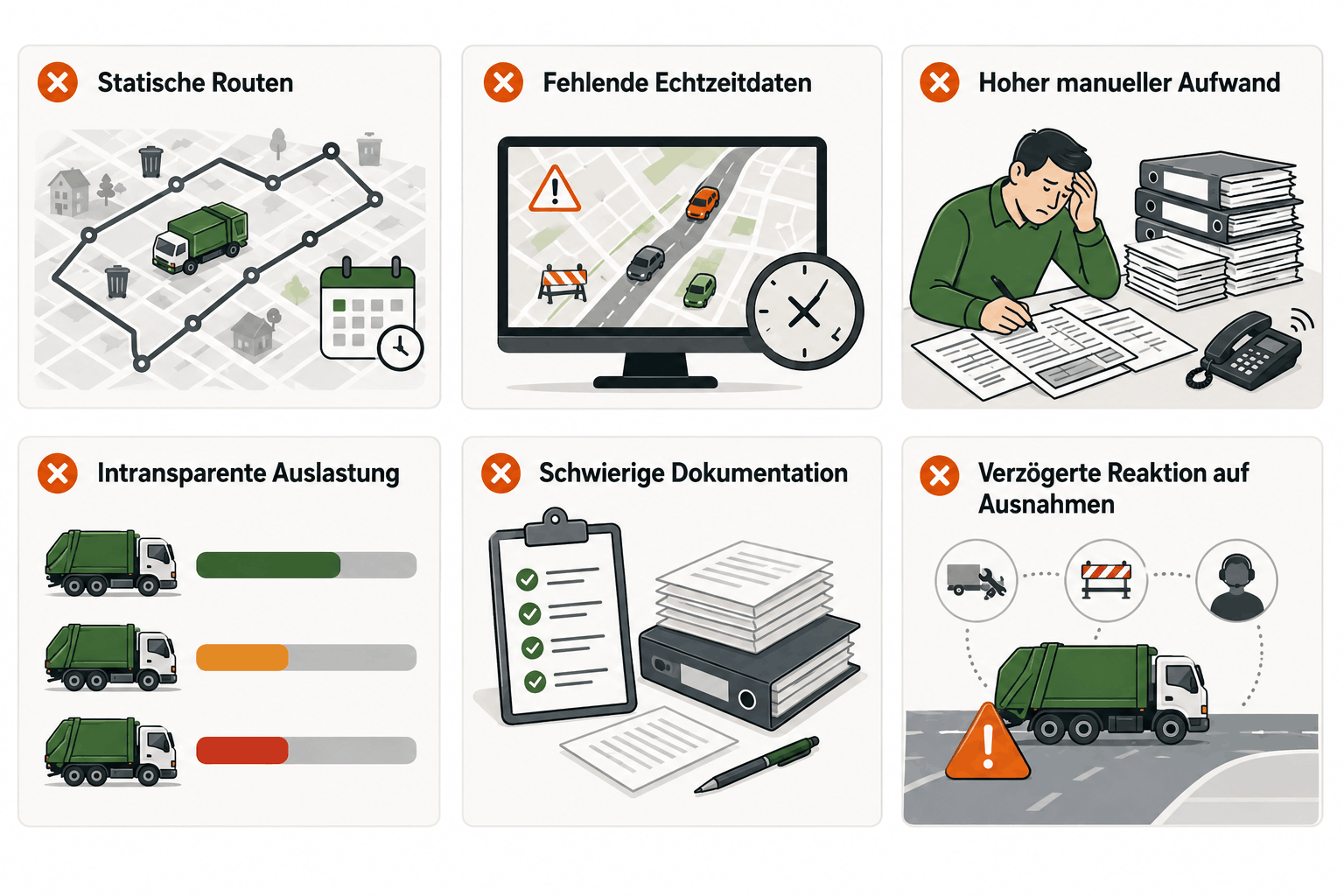
- Static routes: routes set once are often barely adjusted for years, even as new developments, container counts or traffic patterns change.
- No real-time data: without current information on traffic, roadworks or vehicle status, delays cannot be absorbed during the day.
- High manual effort: planning is often done by a few experienced dispatchers, in their heads or in spreadsheets. That is a serious risk when those people are unavailable.
- Opaque utilization: it is often unclear which vehicles are genuinely well used and where capacity is going spare.
- Difficult documentation: evidence of distances actually driven, emptying times or service exceptions is laborious to produce without digital capture.
- Slow response to exceptions: a breakdown, a closed street or a short-notice extra job can only be absorbed with phone calls and improvisation, which costs time and invites mistakes.
These affect municipal collection calendars and commercial waste logistics alike. Only the priorities differ. Municipal work is usually about reliably hitting fixed collection days; commercial operators are focused more on economics and flexibility against changing customer requirements.
One aspect that gets underestimated is the implicit knowledge of individual dispatchers. Someone who has planned the same routes for years knows the shortcuts, the problem spots and the exceptions by heart. That knowledge is valuable and it is also a risk. If that person leaves or falls ill, it goes with them unless it is documented in a system where others can reach it.
How it works
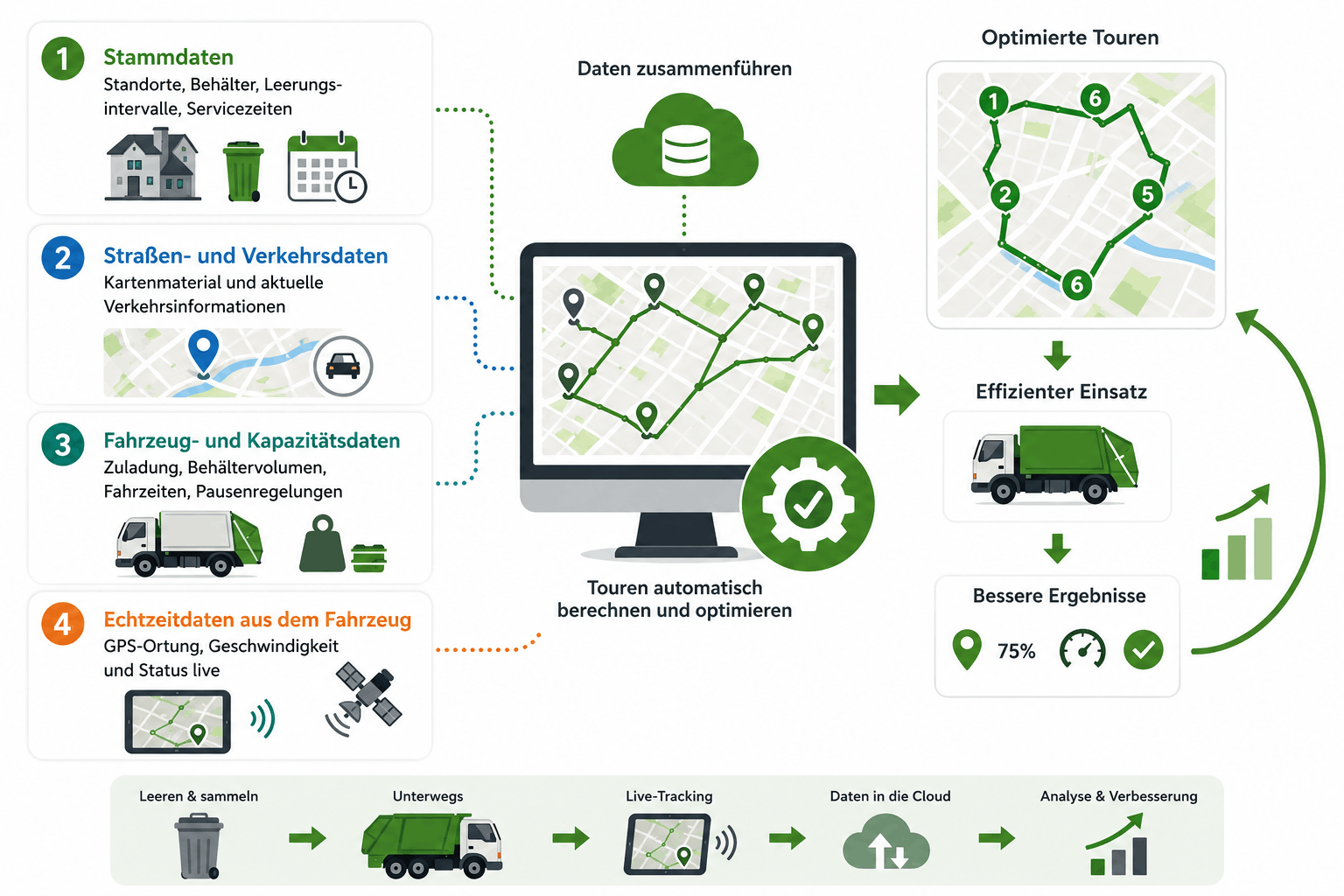
Modern route planning software for waste collection combines several data sources to calculate routes automatically and keep improving them:
- Master data: locations, container types, emptying intervals and service times are the basis of any plan.
- Road and traffic data: digital maps and current traffic information feed the calculation of the best routing.
- Vehicle and capacity data: payload, container volume, driving time and break rules are taken into account.
- Real-time data from the vehicle: GPS tracking makes position, speed and vehicle status visible live.
On that basis, algorithms calculate routes that minimize distance, driving time and the number of vehicles needed, without compromising service quality. If something changes during the day — a closed street, an extra job, a mechanical failure — the route can be adjusted dynamically in many systems rather than replanned from scratch.
Systems differ mainly in how far that automation goes. Simpler products calculate an optimized route for the next day, which is then fixed and handed to the drivers. More advanced systems run continuously in the background and propose adjustments as relevant parameters change. For operations with strongly fluctuating daily work — bulky waste collections, seasonal peaks in garden waste — that dynamic adaptability is often more important than raw algorithm speed.
GPS as part of the picture
A central success factor is GPS tracking of the vehicles, because it is what lets you reconcile the plan with reality:
- Traceability: dispatchers can see where a vehicle is and whether it is on schedule.
- Responsiveness: when there are delays or failures, routes can be redistributed at short notice rather than leaving customers in the dark.
- Evidence: GPS data is objective proof of collections performed, whether for complaints or for contractual service records.
- Data for the next round: the routes actually driven show where the plan diverged from reality, which is valuable input for the next optimization.
Without that real-time transparency, even the most sophisticated route plan stays theoretical. It is the combination of planning and tracking that makes routes genuinely steerable. Many operations also report a less obvious but noticeable side effect: driving changes once distances and standing times are visible. That is less about surveillance than about having a fair, traceable basis for the conversation between dispatch and drivers — explaining an unusual delay, or distributing the demanding routes fairly.
The benefits
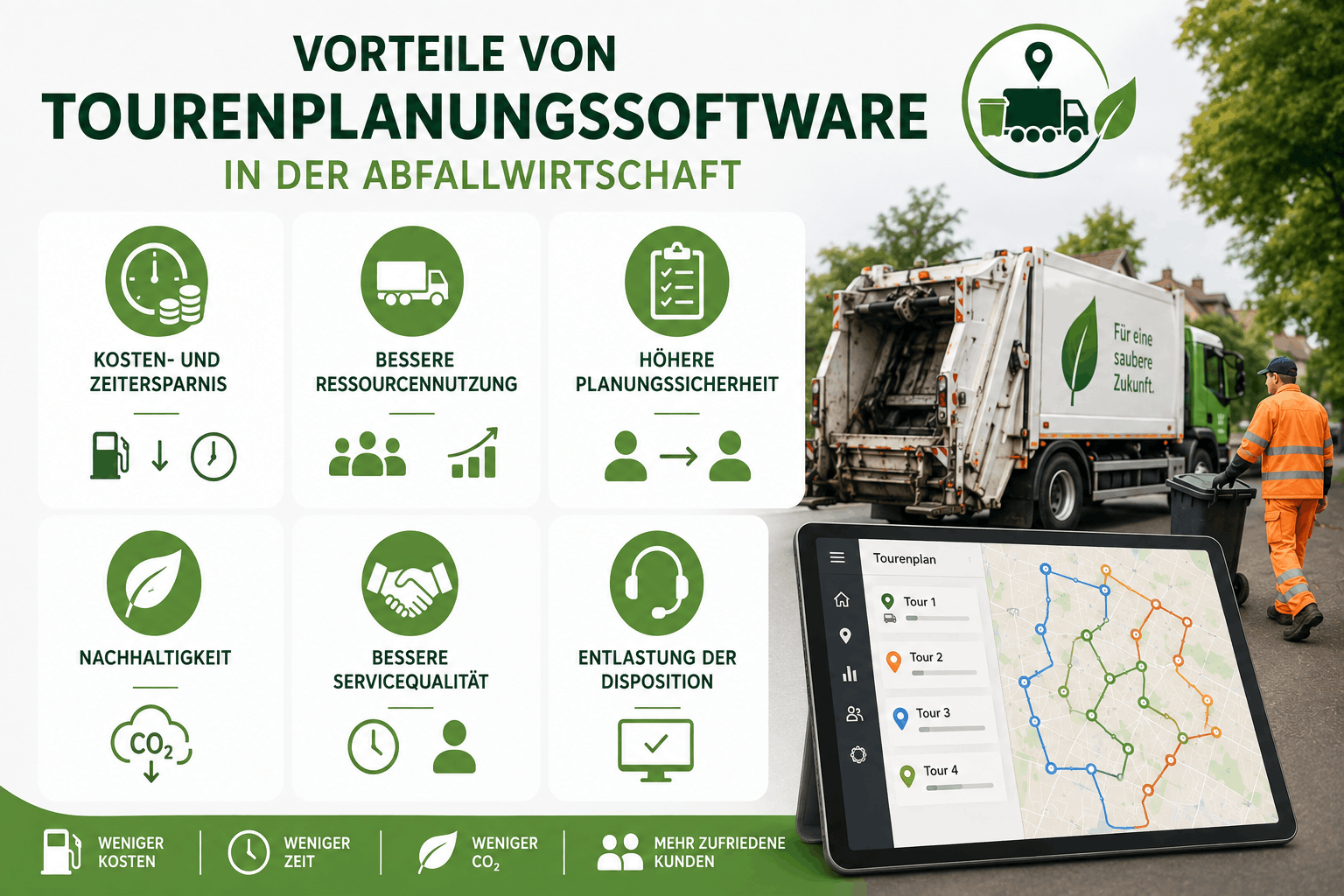
- Cost and time savings: shorter distances and fewer empty miles cut fuel, maintenance and staff hours per route. How much is available in your own fleet is worth calculating with the savings calculator.
- Better use of resources: vehicles and drivers are loaded more evenly, which also makes fleet investment decisions better grounded.
- More planning certainty: digital route plans are not tied to one person's knowledge and are easier to hand over when staff change or fall ill.
- Sustainability: fewer miles means lower emissions, which is increasingly relevant for municipal operations against climate targets, and easier to document to residents and oversight bodies.
- Better service: more realistic time windows and faster reaction to problems increase reliability for residents and commercial customers.
- Relief for dispatch: recurring manual planning work disappears, so dispatchers can concentrate on exceptions and customer queries rather than rebuilding routes every day.
What to look for when choosing
- Industry-specific features: can the software handle different container types, changing emptying intervals and one-off runs, as waste work requires?
- Integration with existing systems: can it connect to your fleet, ERP or billing systems?
- Real-time capability: does it support GPS tracking and dynamic adjustment during the day, or only a static daily plan?
- Usability: can a dispatcher without an IT background work with it quickly?
- Scalability: does it grow when new vehicles, areas or clients arrive?
- Reporting: does it produce comprehensible reports on distance, time and utilization as a basis for continuous improvement?
- Features versus actual need: does it cover the processes you actually want to digitize, or are you paying for modules you will never use?
These criteria already show that not every route planner covers the same requirements. In waste collection the market ranges from focused route optimization tools to extensive telematics and industry systems with container, bin and weighbridge integration. For a cross-industry view there is a broader comparison in the guides to route planning software and route optimization software.
ERP integration instead of an island
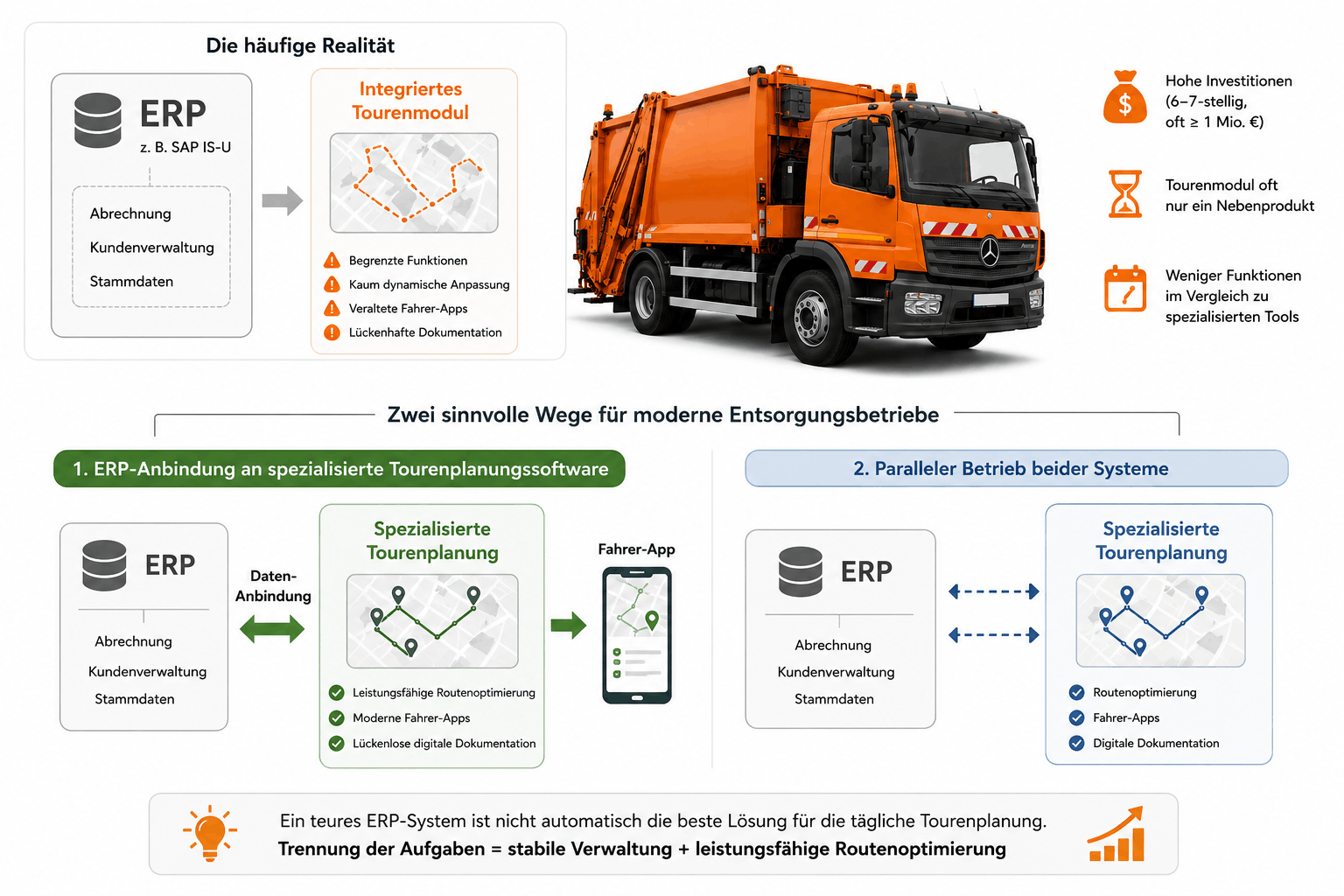
One aspect often gets overlooked. Many waste operations do not plan routes in a standalone tool at all, but in a module inside their ERP system. Industry solutions built on SAP IS-U or comparable systems cover core processes such as billing, customer management and master data, and often bring an integrated route planning module with them.
In practice there is frequently a mismatch. Implementations like that quickly run into six and seven figures, sometimes a million and more. The route planning module inside is often a by-product and is not developed with the same depth as specialized route optimization software. Functions like dynamic adjustment during the day, modern driver apps or complete digital documentation are frequently missing, or look distinctly dated next to specialist tools.
For a modern waste operation there are essentially two sensible paths:
- Connect the ERP to specialized route planning software. Existing master and order data is fed to a dedicated tool that handles optimization, the driver app and documentation, while the ERP stays responsible for billing and administration.
- Run both in parallel. Alternatively ERP and route planning can run independently, where closer integration is not possible or wanted in the short term.
In both cases the underlying idea is the same. An expensive ERP is not automatically the best tool for daily route planning. Separating the two usually gives you both stable administration and considerably more capable route optimization.
Four kinds of software
| Provider | Focus | Price |
|---|---|---|
| COUPLINK | Route optimization, telematics, container and bin management, waste processes | On request |
| SATLOG | Route optimization and telematics for waste and recycling | On request |
| xRouten | Route optimization, time windows, capacities, vehicle profiles, driver app, GPS tracking and documentation | €25/month + €10/driver |
| OptimoRoute | Automatic route planning, driver app, live tracking and proof of delivery | ≈ $38/month per driver |
The full industry suite
COUPLINK goes well beyond route planning, combining route optimization with telematics and functions for container and bin management. Depending on the use case, barcode, QR code or RFID capture, bin sensors and vehicle and yard weighbridges can be integrated into the process.
SATLOG takes a similar approach with a particular focus on waste and recycling operations, and can be embedded in existing IT and ERP structures with larger fleets in mind.
Both are German-market products, and neither publishes standard pricing; costs are quoted individually depending on fleet size, hardware required and the depth of ERP integration. Equivalent suites exist in other markets — the category is what matters here, not the specific vendor. If you need bin-level RFID and weighbridge integration, you are shopping in this category and should expect an implementation project rather than a subscription.
The focused route planner
xRouten concentrates on planning and running routes. Addresses and jobs are imported, optimized automatically and distributed across several routes. Time windows, capacities and different vehicle profiles are taken into account. Through the driver app the planned routes reach the driver directly, with GPS tracking and digital proof including photos or signatures.
This suits waste operations that want to digitize and optimize their routes without introducing a full industry system for every process. The route planner is €25 a month billed annually and includes unlimited routes and addresses. The mobile app for driving and documenting is €10 per month on top. Both excluding tax.
The cross-industry option
OptimoRoute is not built specifically for waste. It is cross-industry and automates distributing jobs across drivers and vehicles, with time windows and capacities taken into account. A driver app, live tracking and digital proof of delivery round it out.
The Lite plan starts at around $35 per driver per month billed annually; the Pro plan is around $44 per driver per month. Since billing is per driver, check carefully how that behaves at larger fleet sizes.
If you want to try route planning at no cost first, 8 free route planners that also optimize has more options.
Which one for which operation
Rather than comparing the four on feature lists alone, it helps to look at typical starting positions.
The municipal operation with a grown ERP: already running an established ERP for billing and master data, but unhappy with the integrated route planning module. Connecting a specialized tool that takes over optimization, the driver app and documentation, without replacing the ERP, is the natural answer.
The operation with extensive bin and container management: if you need barcode, QR or RFID capture and weighbridge integration alongside route optimization, a full industry suite covers more processes from one source.
The recycling or waste operation with a grown IT landscape: where route optimization has to mesh closely with existing telematics and custom ERP structures, a provider built for that integration depth is the fit.
The operation with a mixed fleet beyond waste: if you plan routes not only for collection but also for other delivery or service work, a cross-industry product stays more broadly usable.
In practice it pays to place your own scenario honestly before booking demos. If what you mainly want is lean, quickly introduced route optimization, do not be drawn in by feature lists covering processes you will never run. If you do want to digitize several processes at once, budget openly for the implementation effort and cost that comes with it.
A day, before and after
A clear picture emerges from comparing a typical collection day before and after. Before, dispatch plans the evening before from experience: which vehicle takes which area. If a driver is off sick in the morning, or a street is closed, the route has to be reassembled by hand, often under time pressure and with the risk that individual bins are missed.
With digital optimization, the software handles the base plan automatically from master data, capacities and stored rules. If a vehicle drops out, the affected stops are redistributed to remaining capacity in a few clicks rather than rebuilding the whole day. Through the driver app, the remaining vehicles get their updated route on the device, while dispatch follows progress by GPS. At the end of the day the system produces automatic documentation of distances driven and collections completed, usable for internal review and for evidence to clients or municipalities.
Introducing it, step by step
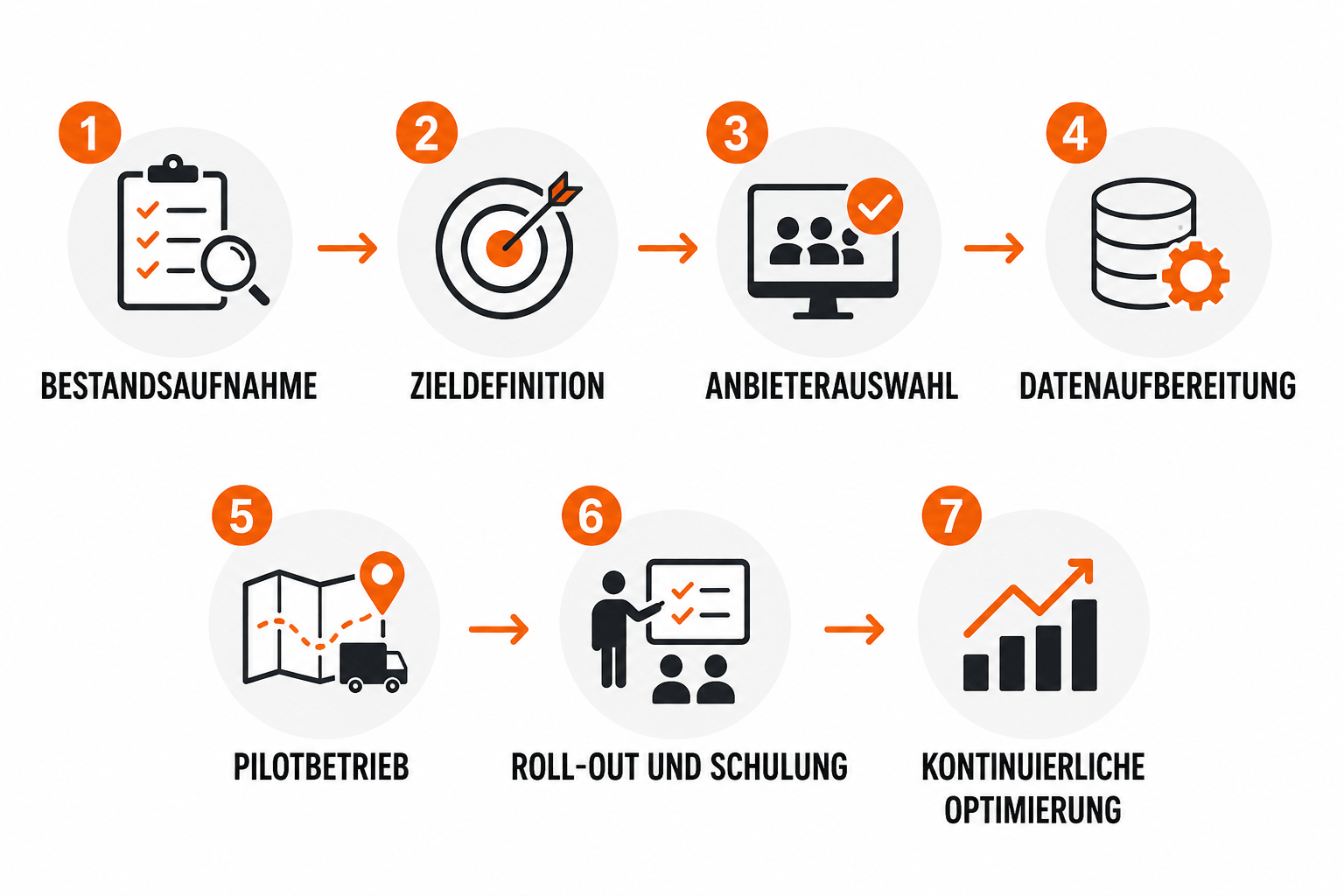
1. Take stock: which routes, vehicles, bins and special cases exist today, and where are the biggest weak points in current planning?
2. Define the goal: is this mainly about better route optimization, or do you also need telematics, container or weighbridge functions?
3. Select a provider: shortlist against the criteria above, then test with demos or trials.
4. Prepare the data: clean up master data on locations, bins and vehicles and move it into the new system, ideally with the vendor's help.
5. Pilot: run one area or a single route digitally in parallel with existing planning, to test practicality and acceptance with dispatch and drivers.
6. Roll out and train: after a successful pilot, extend step by step to more routes and areas, with training for dispatchers and drivers.
7. Keep optimizing: use the reports on distance, time and utilization regularly to adjust routes, rather than setting the software up once and leaving it.
It matters to involve the drivers early. Acceptance problems in practice come less from the technology than from poor communication — when drivers get the impression they are only being watched rather than supported. When it is clear that the app makes daily work easier, through clear navigation, fewer queries and simpler documentation, acceptance rises noticeably.
Where this is heading
Three developments are likely to shape the next few years:
More automation through AI-assisted optimization: instead of routes calculated once a day, more systems will run continuous, learning optimization that recognizes patterns from past routes. Worth reading alongside this: AI route planning is mostly a marketing claim.
Electrification of collection fleets: electric collection vehicles bring new planning requirements, including limited range and charging times, which have to be built into optimization so routes do not fail on an empty battery.
Sensor-based, demand-driven collection: fill-level sensors in bins increasingly make it possible to plan routes by actual need rather than a fixed calendar, which opens up additional savings where waste volumes fluctuate.
Operations investing in digital route planning now also lay the groundwork to benefit from these rather than starting from scratch with each new requirement.
Frequently asked questions
Is digital route optimization worth it for a smaller waste operation?
Yes. Smaller fleets also benefit from optimized routes, since even a few miles saved per day add up noticeably over a year. What matters is choosing something whose features and pricing fit your actual fleet size, rather than over-implementing a solution designed for large operators.
What is the difference between route planning and route optimization?
Route planning is the general process of distributing jobs and stops across vehicles and time windows. Route optimization goes a step further and uses algorithms to pick, from the possible variants, the one with the shortest distance, the shortest times or the best utilization.
Does route optimization software replace dispatch?
No. The software takes over the computationally heavy base planning, but decisions about exceptions, customer communication and strategic adjustments remain with dispatch. It becomes a tool rather than a replacement for experience.
What data is needed?
The most important are the locations to be served, container types, emptying intervals, service times and information on vehicles and their capacities. Depending on the software, traffic data, GPS positions and other real-time information can feed in as well.
Can it connect to an existing ERP?
That depends on the product and on your ERP. Many specialized providers offer interfaces through which master and order data can be taken over, so an existing ERP does not have to be replaced when all you want is to modernize route planning.
What happens with short-notice changes or breakdowns?
Modern systems let routes be replanned at short notice or individual stops redistributed to other vehicles. Depending on the product, updated routes can then be pushed straight to the driver app.
How do I know which product suits my operation?
What decides it is not the largest number of features but your actual need. If you mainly want to optimize routes and coordinate several vehicles, you may not need a full industry suite. If you also need bin management, telematics, weighbridges or complex ERP integration, a more comprehensive system can be the right call.
Try xRouten free for 14 days
Try it now