
This article compares seven route optimization products, explains the math they all run on, and — the part most comparisons skip — shows how the four common pricing models behave as you grow.
The short version
xRouten is the cheapest way in, with a flat rate from €25 a month. It suits delivery services, couriers and trades who want planning, tracking and documentation in one tool.
OptimoRoute is the broadest of the US providers at a low price point, and one of the few with multi-day routes.
Routific has one of the fastest optimizers on the market and is free up to 100 stops a month, which makes it an unusually good way to find out whether optimization helps you at all.
AntsRoute is the European option with strong customer-notification features, including a booking page customers can use themselves.
Track-POD is built around proof of delivery — signatures, photos, barcodes — with routing as the supporting act.
Portatour is the one product here built for field sales rather than delivery: it decides who to visit today based on visit cycles, not on today's orders.
PTV Map&Guide is the industry standard for truck routing, with toll calculation across more than 35 European countries and by far the deepest vehicle profiles.
The right choice depends less on price than on what you actually drive.
1. The technology, and why map data decides more than the algorithm
Before comparing anything, it is worth understanding how these products calculate a route, because the marketing language obscures it.
If you want to go deeper, this is a good introduction: "Traveling Salesman Problem: hard, harder, NP-hard" (YouTube, about 36 minutes).
TSP, VRP and VRPTW
The mathematical basis of all route optimization is the Travelling Salesman Problem. A rep wants to visit several customers and minimize driving time. It sounds simple and is computationally brutal, because the number of possible orderings grows factorially with each stop added. At 10 stops there are already more than 3.6 million possible orders; at 20 stops it is more than 2 quintillion.
Modern algorithms therefore rarely solve the TSP exactly. They use heuristics and metaheuristics, which fall roughly into three groups. Greedy heuristics such as nearest-neighbour build the route step by step, always picking the closest stop not yet visited — fast, and not necessarily good. Improvement heuristics such as 2-opt or Or-opt take an existing route and systematically swap stops until no further improvement is possible. Metaheuristics such as genetic algorithms or Lin-Kernighan search the solution space more broadly, to escape local optima. All three produce very good routes within seconds, even when the result is not mathematically perfect.
TSP covers the case of one driver and many stops: what order does a single driver visit everything in and return to the start?
VRP — the Vehicle Routing Problem — extends that to several vehicles and many orders. Now you also have to decide which vehicle takes which orders, subject to capacity, time windows and driver hours.
VRPTW adds fixed time windows. Every stop has an earliest and latest arrival, so the software has to optimize not only the sequence but the timing, which makes the problem considerably harder.
Why current map data matters more than people think
The best optimizer in the world is worth little on top of stale map data. If a road that opened six months ago is missing, the software plans detours around it. Eight extra miles per route, 20 stops a day, and you are into hundreds of extra miles a month — straight onto fuel cost and delivery times.
Road closures and construction can only be accounted for with current data. Truck restrictions and low-emission zones change regularly, and stale data means wrong routes or tickets. New addresses, especially in new developments, are often missing from older maps. For trucks you also need bridge clearances and weight limits to be correct.
Professional providers therefore refresh their map base several times a year, or use live feeds from TomTom, OpenStreetMap or their own data.
| Provider | Map base | Real-time traffic |
|---|---|---|
| xRouten | OpenStreetMap-based | ✓ |
| OptimoRoute | Not publicly specified | ✓ |
| Routific | Not publicly specified | ✓ |
| AntsRoute | Not publicly specified | ✓ |
| Track-POD | Not publicly specified | ✓ |
| Portatour | TomTom | ✓ |
| PTV Map&Guide | TomTom and OpenStreetMap | ✓ |
OpenStreetMap and commercial maps differ mainly in depth. OSM is high-quality open data maintained continuously by a worldwide community. For standard car and van routing it is very good, and it is used by a great many applications. Its advantages are currency, because the community updates constantly, and independence from any one commercial supplier.
Commercial map data from TomTom or PTV wins where OSM runs thin: detailed truck restrictions such as exact bridge heights and weight limits, complete toll data across Europe, and reliable real-time traffic from large data pools.
For delivery, courier and field-service work, OpenStreetMap is generally entirely sufficient. For truck dispatchers, freight companies and anyone planning across Europe, a commercial base is the safer choice.
2. Pricing models, and what you will actually pay
Pricing is the most confusing part of this market. There are four fundamentally different models and the difference between them is large.
| Model | How it works | Behaves like |
|---|---|---|
| Per driver / per user, monthly | A fixed amount per active driver or user, regardless of stops or routes | Predictable at constant headcount; expensive the moment you plan more routes than you have app-using drivers |
| Per stop or per order | Every stop is counted | Scales directly with volume, which is fair at low volume and punishing at high volume |
| Flat rate | One price for planning, regardless of routes or addresses | Predictable as you grow; usually means the mobile app is priced separately |
| Enterprise licence | One-off purchase plus annual maintenance and support | High entry cost, more customization |
Watch the enterprise model. The licence fee is only the beginning. Annual maintenance of 15–20% of the licence price is normal, and map updates, support packages and training are often extra. Work out the total over three to five years before you sign anything.
Hidden costs worth knowing about
Hardware requirements. Some providers require proprietary GPS units — typically $100 to $300 per vehicle, plus a monthly SIM fee. If you want to stay flexible, choose something that runs on phones and tablets.
Onboarding and training can cost extra, especially on complex systems.
API access is in a higher tier at some providers, which matters if you plan to integrate a CRM or shop system.
Map updates are sometimes billed separately as an annual map licence. Check whether updates are in the price.
3. Prices at a glance
| Provider | Entry price | Model | Notable |
|---|---|---|---|
| xRouten | €25/month (annual, ex VAT) | Flat rate | Unlimited routes and addresses. Mobile app +€10/month per driver. |
| OptimoRoute | ≈ $34/driver/month | Per driver | Multi-day routes on the higher tier. |
| Routific | $0 up to 100 stops/month | Per stop | ≈ $150/month up to 1,000 stops. |
| AntsRoute | €34/vehicle/month | Per vehicle | Key features only on the Pro tier (€74/vehicle/month). |
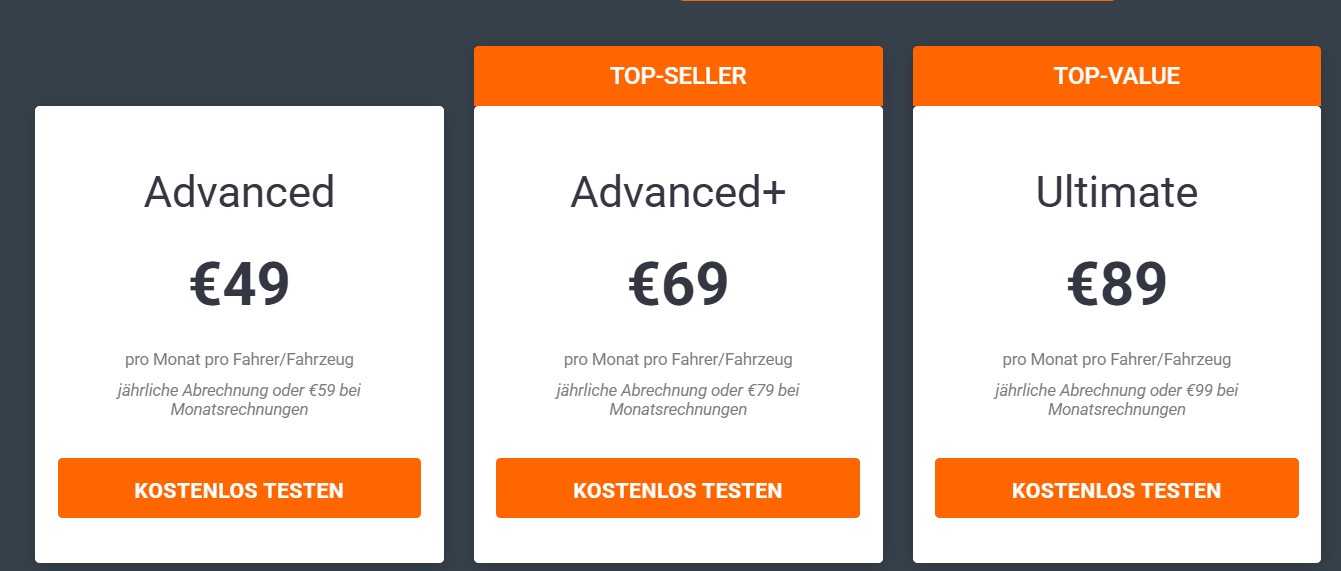
| Track-POD | €49/driver/month | Per driver | Also offers per-order pricing. |
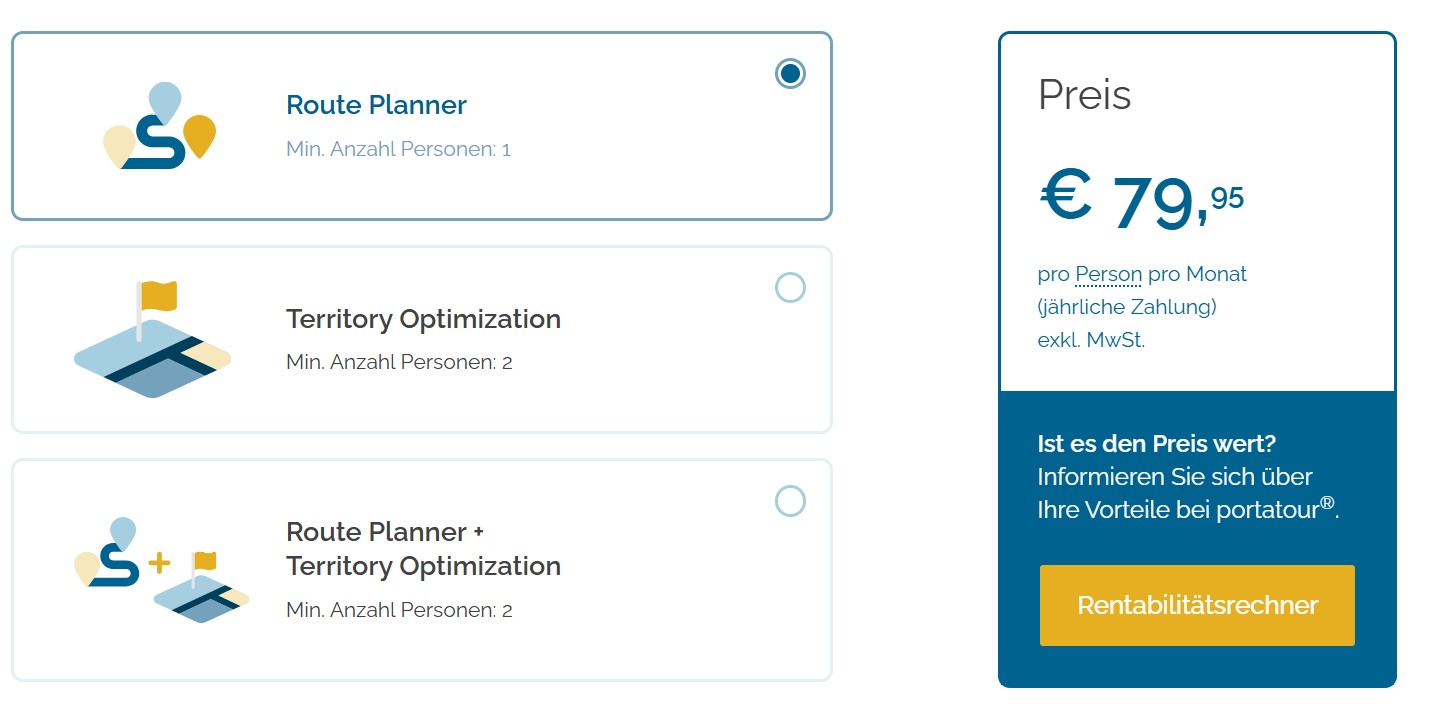
| Portatour | €79.95/user/month | Per user | Territory optimization tier at €129.95/user/month. |
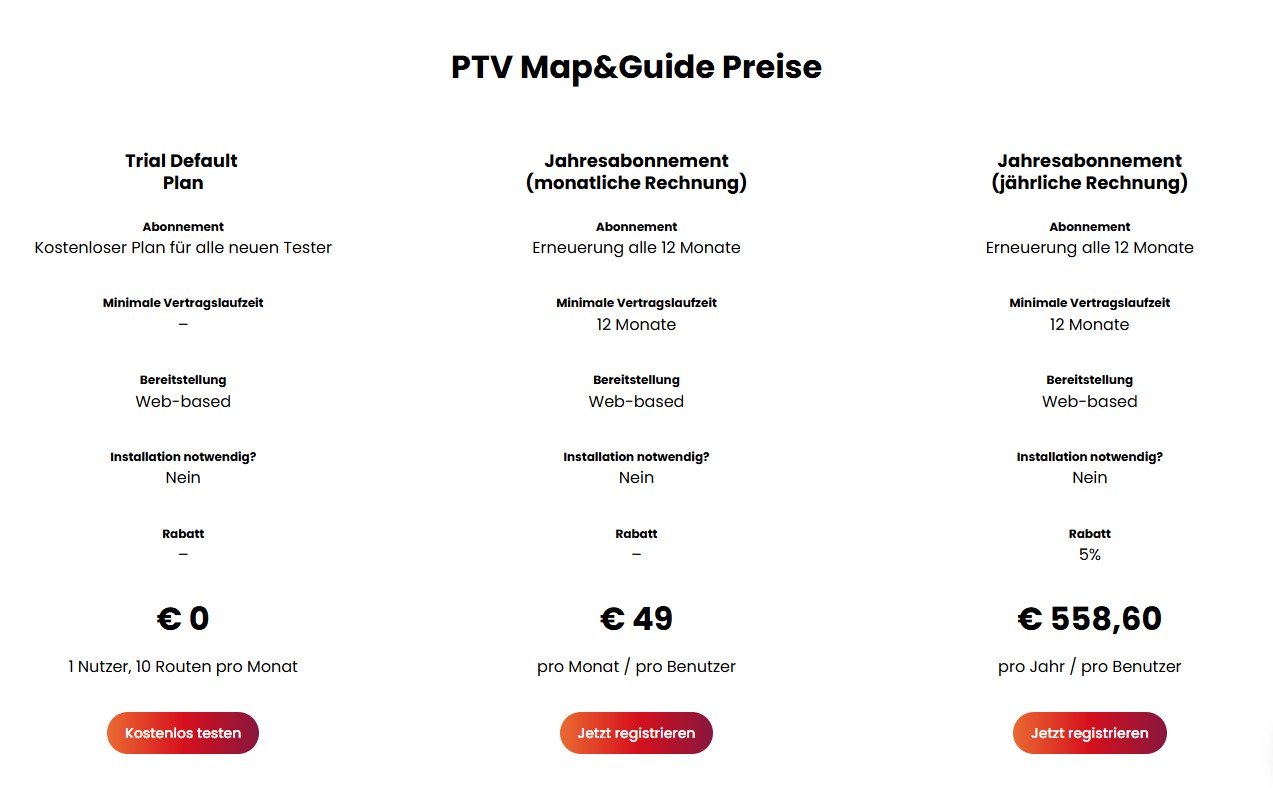
| PTV Map&Guide | €0 trial (1 user, 10 routes/month) | 12-month subscription | Full version €49/user/month. |
Prices as published September 2026. Check before you buy; this part of the market moves.
4. The providers in detail
xRouten
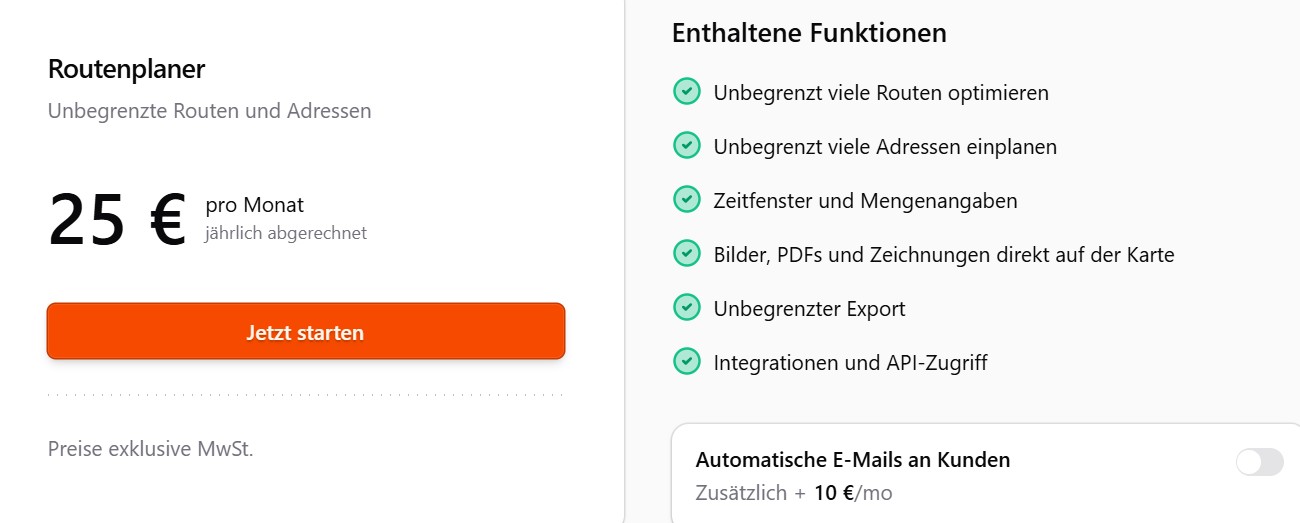
A cloud product developed and hosted in Germany that puts route planning, optimization, live tracking, digital documentation and customer tracking links in one platform. Addresses import from a spreadsheet or go in by hand. Time windows and vehicle capacities are taken into account automatically.
Price: €25 per month billed annually, including unlimited routes and addresses, time windows and quantities, integrations and API access, and unlimited export. The mobile app is optional at €10 per driver per month and includes live tracking, proof with photos and signatures, tasks and checklists, and location and timestamps.
- Pricing model: flat rate for planning, per driver for the app
- Time windows: yes
- Capacity constraints: yes
- GPS live tracking: yes, via the app
- Proof of delivery: photo, signature
- Mobile app: iOS and Android
- Hardware: none required
- API: yes, in the base price
✅ Strengths: planning, tracking and documentation on one platform. Transparent, low pricing. Servers in Germany. Quick to learn. API in the base package.
❌ Limits: no multi-day routes. No truck-specific routing. No CRM integration for field sales.
Best for: delivery services, couriers, trades and municipal services — anyone planning routes daily who wants the documentation to come with it.
OptimoRoute

One of the best-known international products, with a broad feature set at a low price point among US providers. Recurring and multi-day routes are possible on the higher tier, which few competitors here offer.
Price: from around $34 per driver per month; about $44 with proof of delivery included.
✅ Strengths: multi-day and recurring routes. Broad feature set. In-app customer feedback.
❌ Limits: every parallel route needs its own driver seat, whether or not that driver uses the app. Users report routing inaccuracies accumulating past 100 stops, and limited flexibility once a route is underway. Data on US servers.
Best for: service businesses mixing deliveries with field visits, with a stable number of active drivers.
Routific
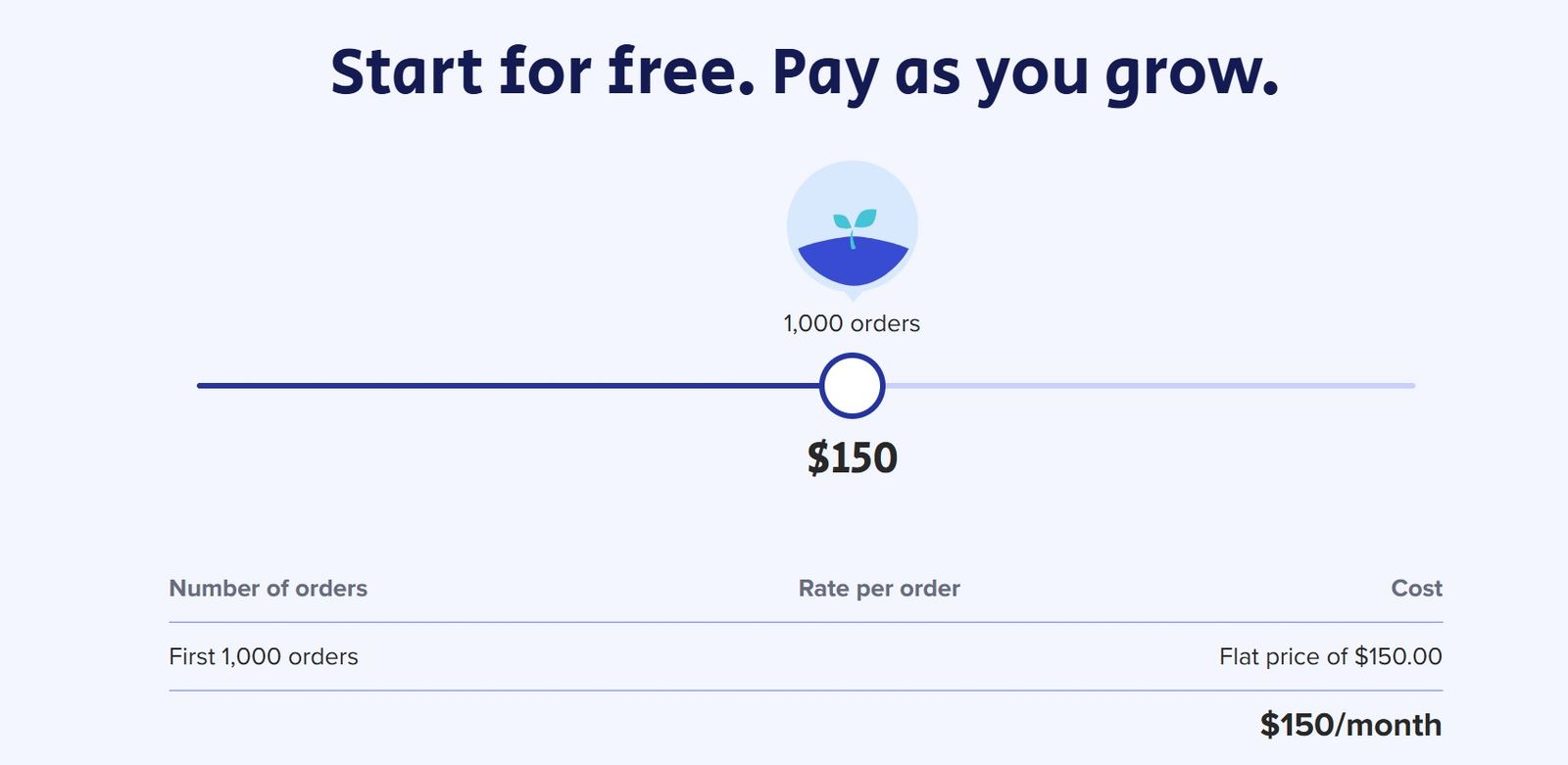
Mature product, clean interface, one of the fastest optimizers on the market, and an unusual pricing model: free up to 100 stops a month, then around $150 for up to 1,000.
✅ Strengths: excellent algorithm. Free tier that is genuinely usable. Strong API documentation. No per-driver seats — only addresses count.
❌ Limits: sharp price jump past the free tier. English-only support. Servers in the US and Canada, so no GDPR guarantee.
Best for: teams that want the best optimization quality and do not need EU data residency.
AntsRoute
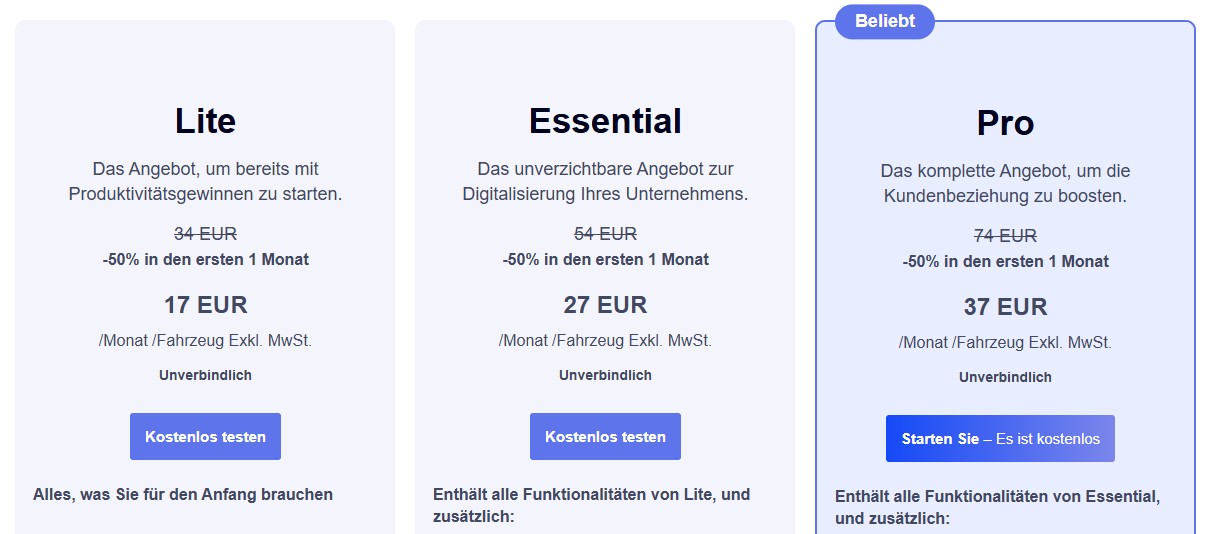
A French product, well established across Europe, with automatic route optimization, a driver app, and the strongest customer-communication features in this comparison: SMS and email notifications, and on the Pro tier a 24/7 online booking page that customers use themselves.
Price: from €34 per vehicle per month; the Pro tier with booking, geotracking links and post-job ratings is €74 per vehicle per month.
✅ Strengths: intuitive interface. Automatic customer messaging. EU servers.
❌ Limits: billing per vehicle, whether or not the app is used. The features that distinguish AntsRoute are only on the most expensive tier. Support in French and English.
Best for: service businesses where customers book their own appointment slots.
Track-POD
Latvian product focused on digital proof of delivery: signatures, photos, barcodes. Also logs cash collected on delivery, odometer and fuel readings, and load checks before departure.
Price: from €49 per driver per month, €69 with the extended feature set. There is also a per-order model — 1,500 orders for €285, roughly €0.19 an order, falling as volume rises.
✅ Strengths: the most thorough documentation features here. Barcode scanning. Per-order pricing as an alternative to per-seat.
❌ Limits: route optimization is not the focus. Comparatively expensive per driver.
Best for: operations where documenting every delivery matters more than shaving the last mile off the route.
Portatour
Built for field sales rather than dispatch. You set how often each customer should be visited, and the software automatically plans day routes that respect those intervals. The question it answers is "who should I visit today", not "what order do today's orders go in".
Price: €79.95 per person per month billed annually. The tier with territory optimization is €129.95 per person per month and requires at least two users.
✅ Strengths: the only product here built specifically for field sales. Automatic visit suggestions and territory optimization. CRM integration including Salesforce and SAP.
❌ Limits: not suitable for delivery or truck work. No proof of delivery, no tracking links. Annual payment required.
Best for: pharma reps, field sales, key account managers.
PTV Map&Guide
PTV, out of Karlsruhe, is the industry standard for truck routing in Europe. What sets Map&Guide apart is the depth of truck-specific data: vehicle profiles with height, width, axle load and dangerous-goods classes; toll calculation in more than 35 European countries; low-emission zones, truck bans and current roadworks, all native and continuously updated.
Price: free trial for one user with 10 routes a month. Full version €49 per user per month, or €558.60 per user per year, both with a 12-month minimum term.
✅ Strengths: the deepest truck vehicle profiles on the market. Toll calculation across Europe. Electric truck planning with 400+ models. Continuous map updates.
❌ Limits: 12-month minimum term. Less suitable for courier work or last mile. No integrated proof of delivery.
Best for: freight companies and shippers planning truck routes where tolls, driving-time rules and vehicle profiles have to be right.
5. Verdict
The choice depends less on price than on the actual application.
Small delivery and courier operations with one to three drivers do best on xRouten or Routific, both of which are transparently priced and usable immediately with no setup project. If you also need live tracking and GPS for 5 to 20 drivers, compare xRouten and OptimoRoute on total cost, because the per-driver model is where the gap opens up.
Field sales is Portatour, and it is not close — nothing else here takes visit intervals and customer priorities seriously.
Truck dispatchers who need toll calculation and vehicle-specific routing will struggle to avoid PTV Map&Guide.
If what matters most is documenting every delivery, Track-POD is built for it. If customers should book their own slots, AntsRoute is the one with that feature.
Checklist before you buy:
- Where is the data stored, and is there a data processing agreement?
- Total cost including maintenance and map updates
- Hardware requirements
- Use the trial, with your own addresses
- Talk to the drivers — adoption decides whether any of this works
6. Frequently asked questions
What is the difference between route planning and route optimization?
Route planning means putting stops in an order — manually, in Google Maps, for instance. Route optimization means calculating the most efficient order automatically, taking time windows, vehicle capacity, traffic and other factors into account. Optimization software distributes 50 customer addresses across 3 vehicles automatically and calculates the routes in seconds.
How many stops can route optimization software handle?
It varies by provider and plan. xRouten, for instance, supports an unlimited number of stops. For most mid-sized use cases, 50 to 150 stops a day is more than enough. What matters more is whether the software can recalculate quickly when something changes.
Do I need GPS hardware, or is an app enough?
Most modern providers work without proprietary hardware and run on phones and tablets. Be wary of providers who require hardware — it limits you long term and adds cost.
What are tracking links?
Tracking links give end customers live updates, the way parcel carriers do. The customer gets a link by text or email, sees the driver's current position and the estimated arrival time. It cuts "where is my delivery" calls noticeably.
Is cloud-based route optimization software secure?
It can be, if the provider is GDPR-compliant and runs servers in a jurisdiction that suits you. Look for a data processing agreement, encryption in transit and at rest, and certifications such as ISO 27001. The advantage of cloud products is that updates arrive automatically.
Can I connect route optimization software to my CRM?
Most providers offer an API or direct CRM integrations. Portatour supports Salesforce and SAP natively. xRouten offers an open API in the base package. For field sales, CRM integration is usually essential, so that visit reports and customer data synchronize rather than being typed twice.

Try xRouten free for 14 days
Try it now