

The short version
You read "AI route planning" and "AI route optimization" and think ChatGPT is now planning your routes. That impression is, in most cases, exactly what the vendor intended. So: misleading marketing, or an outright falsehood? This article sets out how much AI is genuinely in route planning and optimization, what machine learning has to do with it, and where the technology is actually heading — so you are not dazzled into the wrong purchase.
"AI" is being used as a label for technologies that have existed for decades, long before the word became a selling point. A buyer who does not know what is underneath pays for a promise the technology does not keep.
Everyone is on the same train
Picture yourself as a dispatcher at a mid-sized transport company. At a trade show, or in a LinkedIn ad, you come across software promising:
Optimize your routes with AI.
The natural inference is that the software works something like ChatGPT. You imagine an assistant you can talk to, that understands orders, spots problems and works out the best route for each driver on its own. Tuned to your fleet, fully automated, endlessly adaptable. Plenty of companies will pay a premium for that promise.
In practice the technical reality is usually different. That gap — between the expectation the word "AI" creates and the technology actually in use — is what this article is about.
Since the AI boom, "AI" has become a powerful marketing term for software vendors. The label signals innovation, helps with positioning, and attracts attention in tenders and investor conversations. What usually stays unclear is which form of artificial intelligence is actually in play. At best the underlying technology is described superficially. At worst the impression is created of AI functionality that does not exist in that form at all.
What vendors actually claim

Homepages say "AI-powered route optimization", "intelligent real-time route planning", "AI-based navigation for your fleet", "the AI route planner for efficient logistics". The wording varies; the pattern does not.
Almost nobody says what the "AI" actually does. Most vendors do not explain which model, which algorithm or which data they mean. There are no efficiency benchmarks, no concrete numbers, and no clear statement about whether real-time data genuinely feeds in or whether this is a classic planning tool in modern packaging.
Below are three concrete examples. They come from the German-speaking market, because that is where we checked the actual wording on the actual pages rather than generalizing. The pattern is the same everywhere.
Example 1
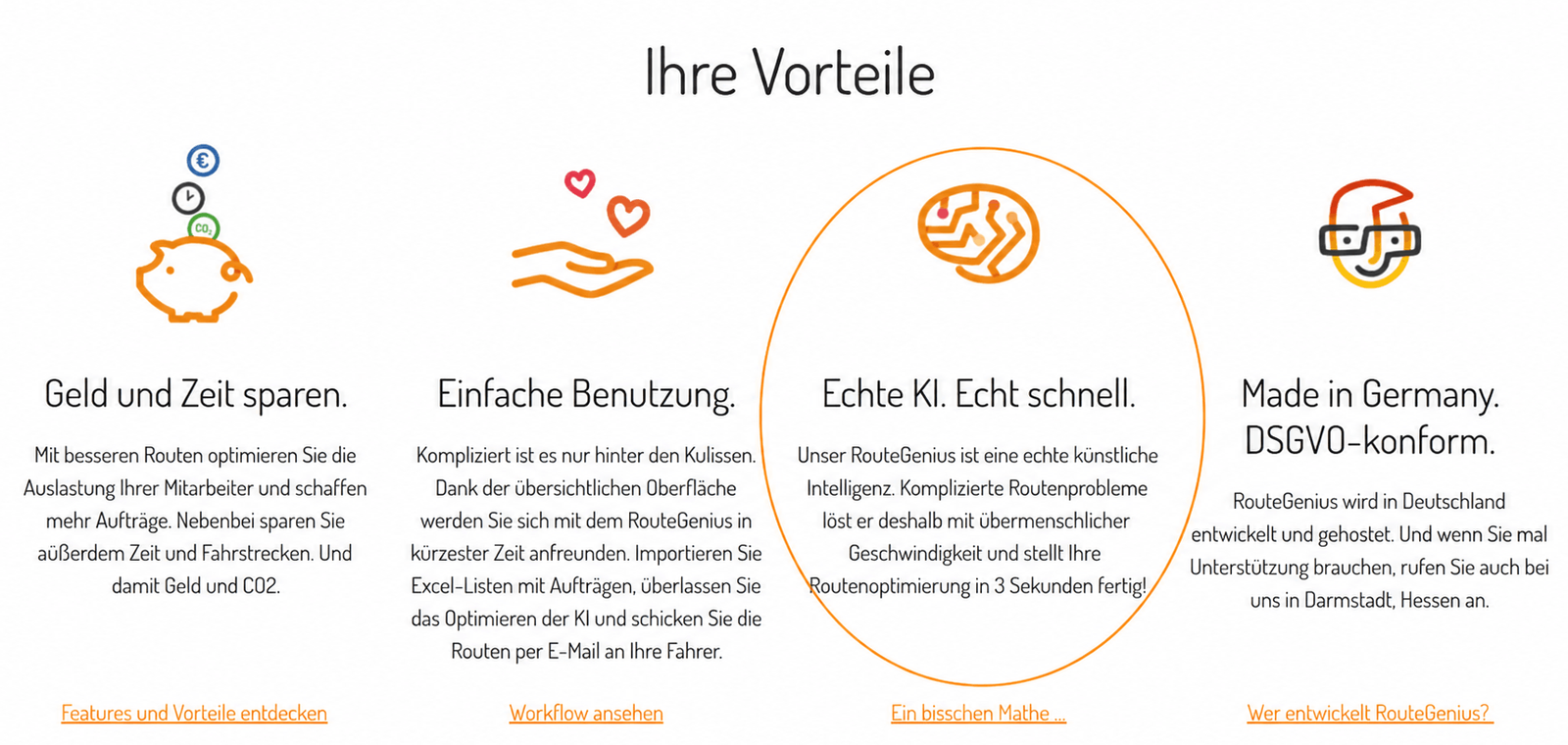
RouteGenius advertises "Real AI. Really fast." and describes itself as genuine artificial intelligence solving complicated routing problems at superhuman speed. Elsewhere the vendor is more honest than most, explaining that the software solves a combinatorial optimization problem — with 3 drivers and 15 orders there are already over 14 million possibilities. That puzzle is explained further down. What remains open is what the "real AI" concretely does that goes beyond classical optimization algorithms.
Example 2

xpertour markets itself as "route planning with AI and route optimization in the browser" and promises up to 20 percent lower route costs and up to 80 percent less dispatch time. The page refers to "scientifically researched AI algorithms", which is at least a hint at the technical basis. Time-of-day-dependent travel times can also be taken into account in the optimization. That traffic prediction is, as set out below, genuine AI — but usually rented rather than built. What remains open is where those travel-time figures actually come from.
Example 3
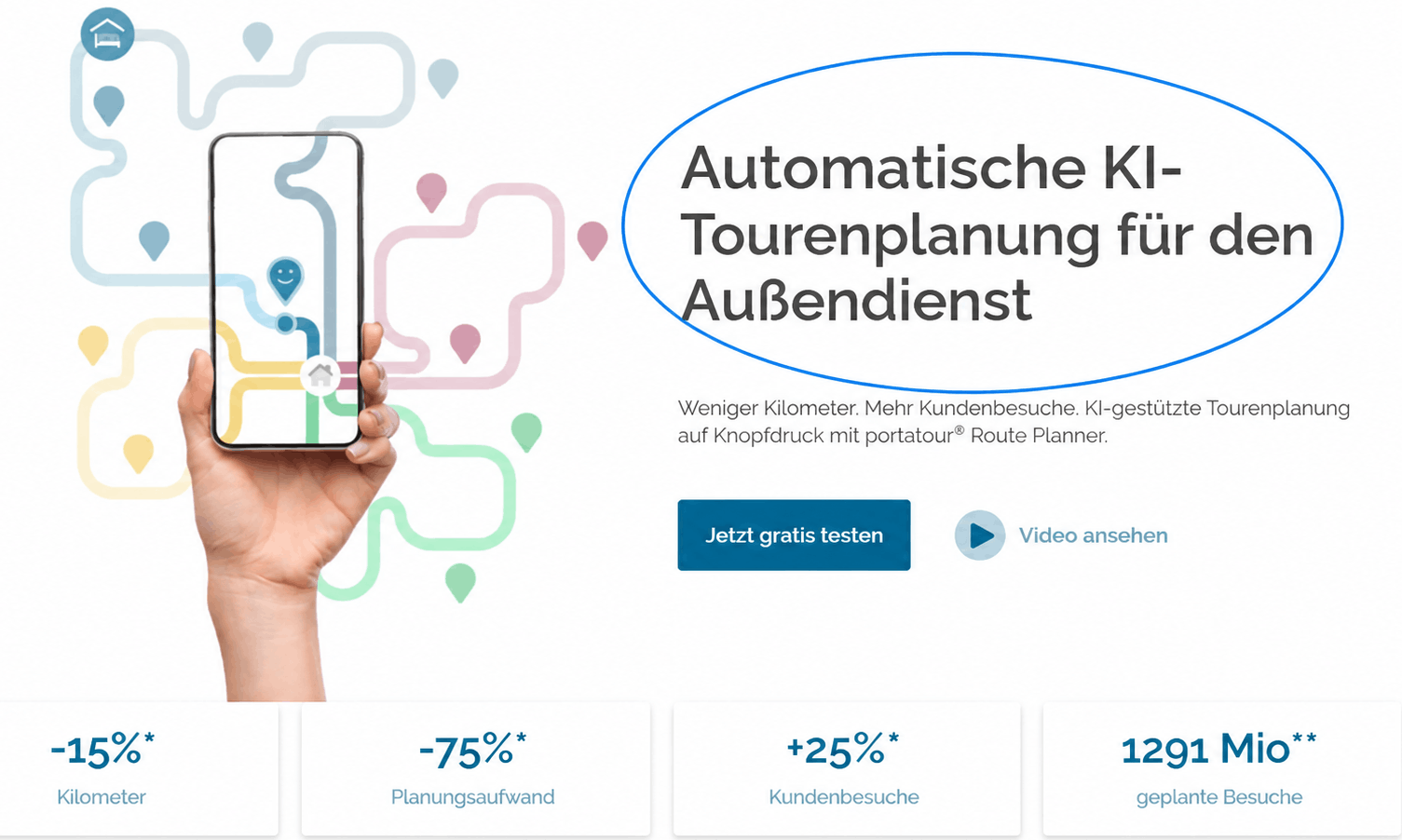
portatour® is the only one of the three that actually explains on its website what sits behind the "AI" label. The FAQ describes a heuristic algorithm with swarm intelligence that calculates optimized routes even in complex data situations, analyzing hundreds of thousands to millions of possible routes iteratively. More striking still is its own legal notice, which states that heuristic methods fall, in the European Commission's view, outside the scope of the EU AI Act.
What is remarkable there is less the algorithm than the communication. While the legal notice explicitly places the described heuristic algorithm outside the scope of the AI Act, the same product is marketed on the homepage as "automatic AI route planning".
The pattern is similar across all three. Two name "AI" without fully explaining what they mean by it. One explains it, and concedes in the process that its own algorithm is not legally classified as AI. Not one of them says where the traffic and travel-time data feeding the calculation comes from.
Vendors who do not use the label
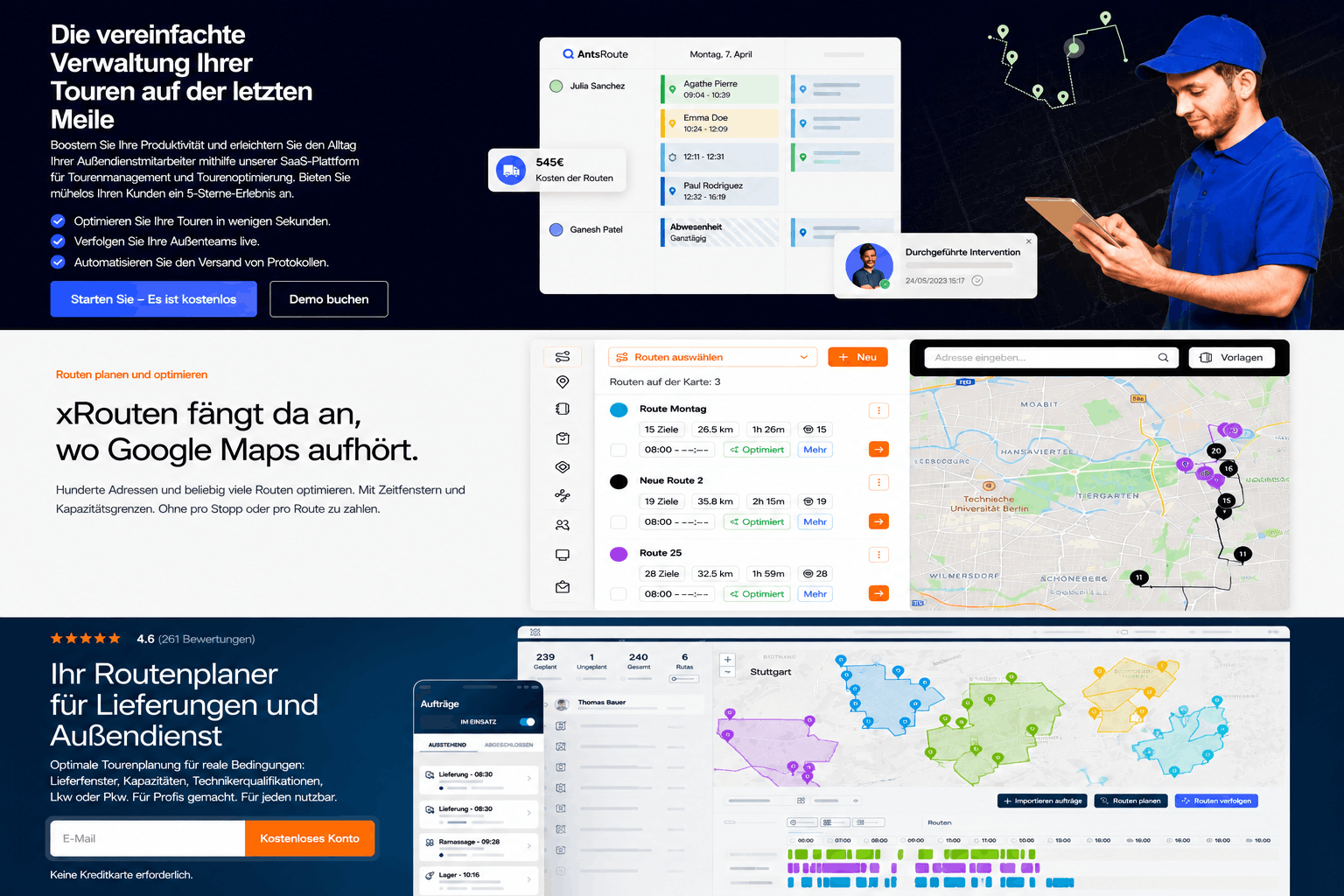
Some vendors deliberately do without it.
- AntsRoute: the product pages refer only to "powerful algorithms" that calculate the best routes. No "AI-powered", no "AI-driven". The product is described as what it is.
- xRouten: likewise no promises of "AI-powered route planning". The product is described as what it is: route optimization based on algorithms.
- OptimoRoute: the core product pages consistently talk about "intelligent planning algorithms", not AI.
At first glance that is unremarkable. In the context of this article it is a signal of transparency. Where many vendors use the word "AI" without explaining what technology is behind it, these three decline the upgrade in the place where it counts. The software optimizes routes, the algorithms produce results you can rely on, and the benefit is measurable.
How route optimization actually works
First, a distinction. This article is not about simple navigation from A to B, which Google Maps already solves very reliably. That problem is comparatively manageable and modern navigation systems calculate it in close to real time.
The real challenge for dispatchers and transport companies is elsewhere: planning complex routes with many stops, several vehicles and a lot of constraints. Delivery time windows, load capacity, driving times, driver shift hours, weather, road restrictions. All of those have to be considered at once, even when conditions change at short notice.
At around 20 stops there are already more possible orderings than a person could realistically examine. Add several vehicles, travel-duration requirements and further restrictions and the number of combinations grows enormously. So professional route optimization software does not check every variant. It uses specialized methods to search for a very good solution in a short time.
The basis is mathematical algorithms. This is not intuition or guesswork; it is a structured search of a solution space. The result is efficient, automated and reproducible. And importantly: these algorithms are not new. Methods like branch-and-bound, savings algorithms and metaheuristics for the Vehicle Routing Problem have existed since the 1950s and 1960s — decades before "AI" became a selling point. They have nothing to do with the kind of artificial intelligence that became popular with ChatGPT.
That optimization software is the actual product being marketed as "AI route planning" or "intelligent trip planner". Technically it is mathematics, not a thinking system. Which also makes clear why a chatbot is the wrong tool for the job: it does not calculate a reliably optimized route, it generates suggestions based on probabilities.
Even if real AI were used, you would get worse routes and pay more
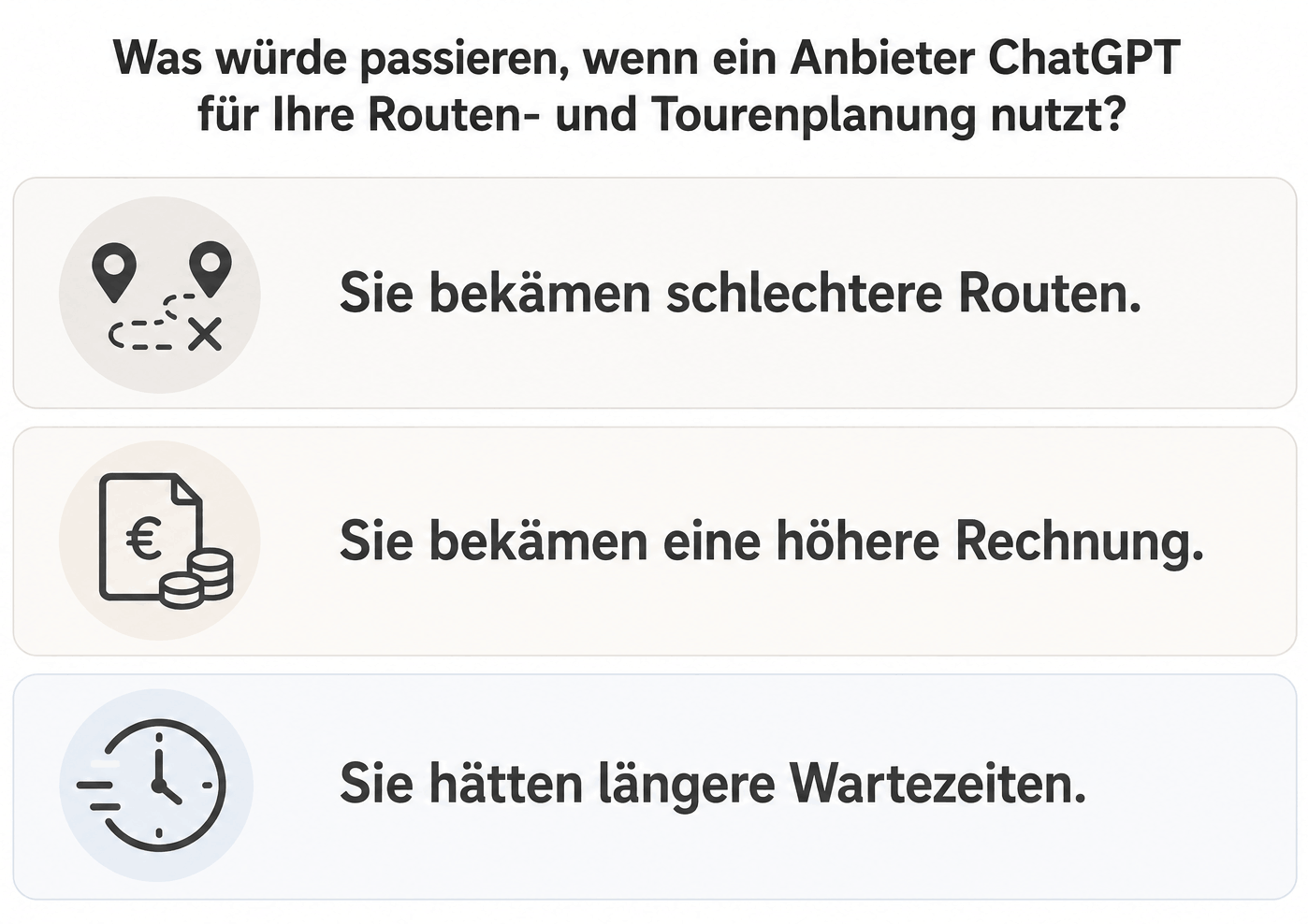
Suppose a vendor genuinely did use a language model like ChatGPT for route planning. What would the practical consequences be?
You would get worse routes. An LLM-based assistant guesses rather than calculates. It does not perform combinatorial optimization, and it is not deterministic — the same input can produce different suggestions, with no guarantee that any of them is mathematically good. At a few dozen stops the system becomes unreliable. At real order volumes it is hopeless.
You would get a bigger bill. Costs accrue per request and rise with the number of stops. Planning 50 stops with a tool like this would not be a flat monthly fee but an ongoing cost problem.
You would wait longer. Instead of milliseconds, a request takes seconds, plus possible rate limits. For a dispatcher distributing 200 orders in the morning while watching driving time, fuel and customer satisfaction, that is a real problem. Planning in seconds would be off the table.
The conclusion: the established optimization software that has existed for decades is mature, immediately usable and better suited to this task. A language-model-based tool would be slower, more expensive and less reliable.
Where AI genuinely is, and why it is not the AI you are picturing
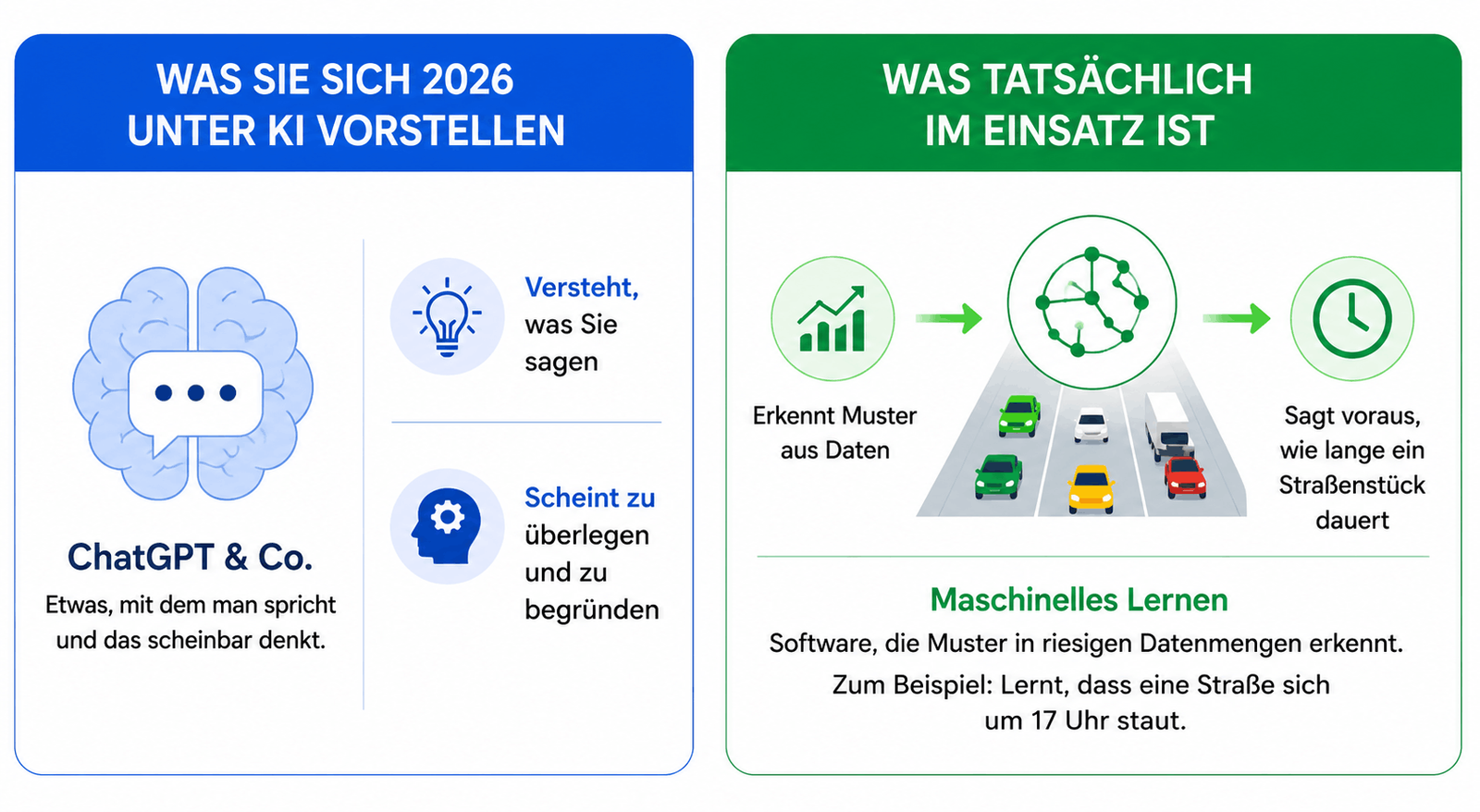
There is real machine learning in modern route optimization. It is mostly in predicting traffic. How long does a stretch of road take at a particular time of day? How is traffic developing right now? What weather conditions affect travel time? That is genuine machine learning, and a form of artificial intelligence that works well here.
But here is the crucial framing. This kind of AI is not new. Google Maps was using machine learning for traffic prediction and arrival times years before the current AI hype. At the time almost nobody called it an "AI route planner", because it was simply good engineering.
So there are two kinds of "AI", and the difference explains nearly everything.
The AI you picture in 2026 is ChatGPT — an assistant or chatbot. Something you talk to, that appears to think, gives tailored recommendations, generates images and diagrams and responds flexibly to what you want.
Machine learning, by contrast, is software that finds patterns in very large amounts of data. It learns that a particular road is regularly congested at 5pm, or that certain weather makes a route less attractive. Google Maps has used this second kind successfully for years, without a large "AI-powered" banner. But that is not the picture most advertising is trying to put in your head.
The AI predicts the traffic. It does not calculate the optimal route.
Three levels: who builds the AI, who rents it, who relabels it
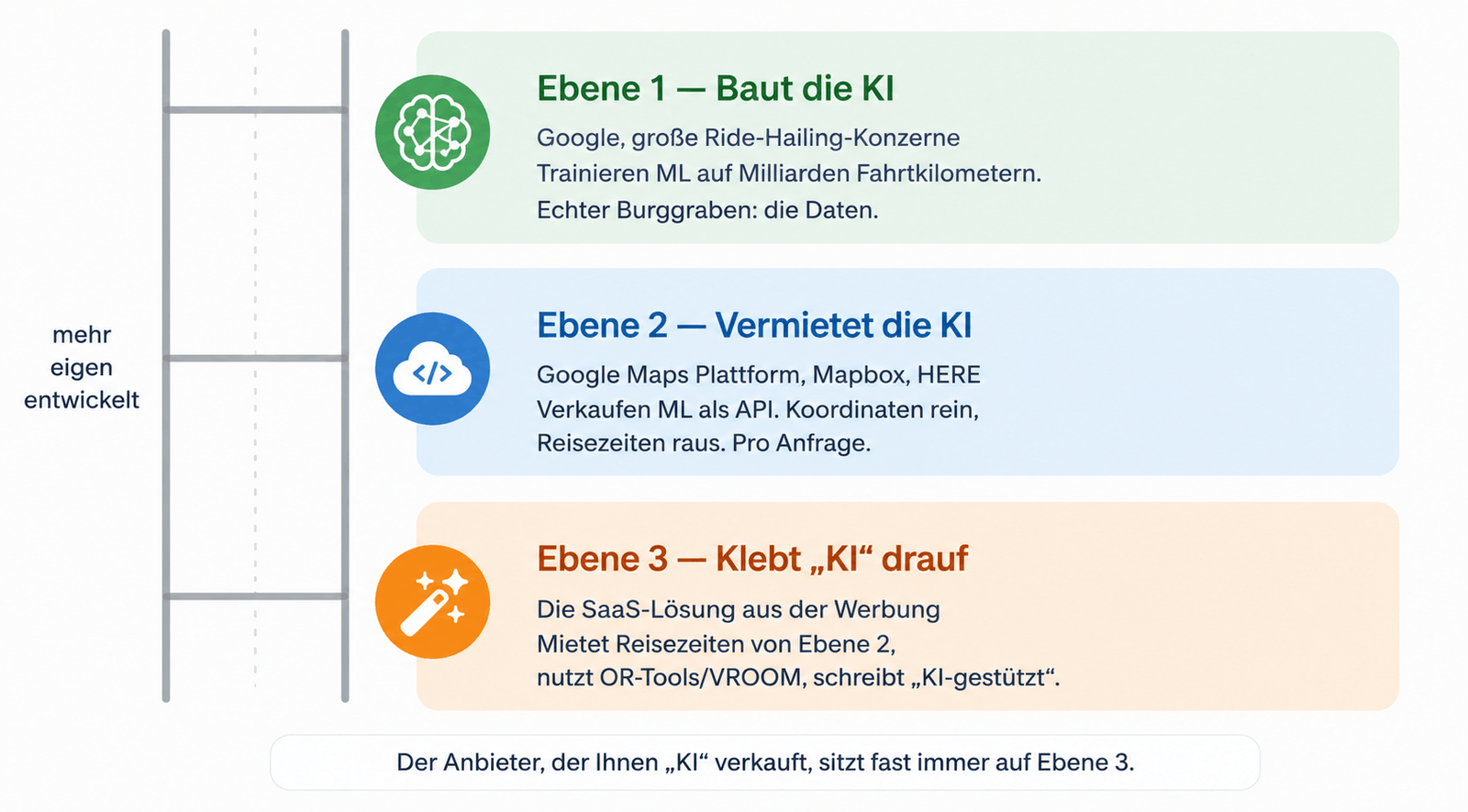
Picture a ladder, from the top down.
Level 1: the few who actually build it. Google and a small number of companies of similar size train real machine learning models on enormous volumes of data from actual driving. Traffic, weather, travel times, incidents all feed the models. The moat is the data volume. Without billions of driven miles there is no reliable model.
Level 2: the providers who package and rent that technology. Google Maps Platform, Mapbox, HERE. They sell machine learning as an API. Coordinates and stops go in, calculated travel times come out. These are genuine machine learning applications, billed per request.
Level 3: the "AI route planning" vendors you saw in the ad. They generally do not build any of this. Instead they rent travel-time data from the providers above, feed it into a freely available or classical optimization solver, and write "AI-powered", "intelligent" or "AI planner" on the homepage.
The transport company or tool vendor selling you "AI route planning" is almost always on level 3. The only "AI" in the entire stack was built at level 1, rented through level 2, and predicts traffic. It does not plan your route. These vendors have not built an AI. And the AI they have rented does not do what the product name implies.
But is nobody building real AI route planning?
There is an active research field investigating how artificial intelligence can be applied directly to complex routing problems, including large language models, neural networks and AI assistants for demanding logistics scenarios with high order volume, real-time adaptation and unforeseen events. That research is real, relevant and to be taken seriously.
The current state of it is considerably more sober than the marketing suggests. The approaches are promising but mostly still experimental, and on real, complex problems they do not yet reliably beat established classical optimization methods. Efficiency and solution quality often fall away as problem size grows — more stops, more vehicles, more constraints.
One useful indicator is a 2026 review published in IEEE Access titled "Route Optimization Reimagined: Multi-Modal Large Language Models for Next-Generation Vehicle Routing". The title sounds advanced. The authors' own assessment is markedly more cautious: they describe AI-based route optimization as a promising but under-researched approach with open challenges and a need for further research. A peer-reviewed paper from 2026 therefore places these technologies in the category of future field, not established industry standard.
Part of an honest assessment is also that classical optimization algorithms can hit their limits in highly dynamic, data-rich real-time scenarios with many unforeseen events. That is precisely why the research is active. It does not follow that vendors can today offer a fully mature "AI tool" or a production-ready "AI planner" for complex route planning.
How to check what your vendor actually uses
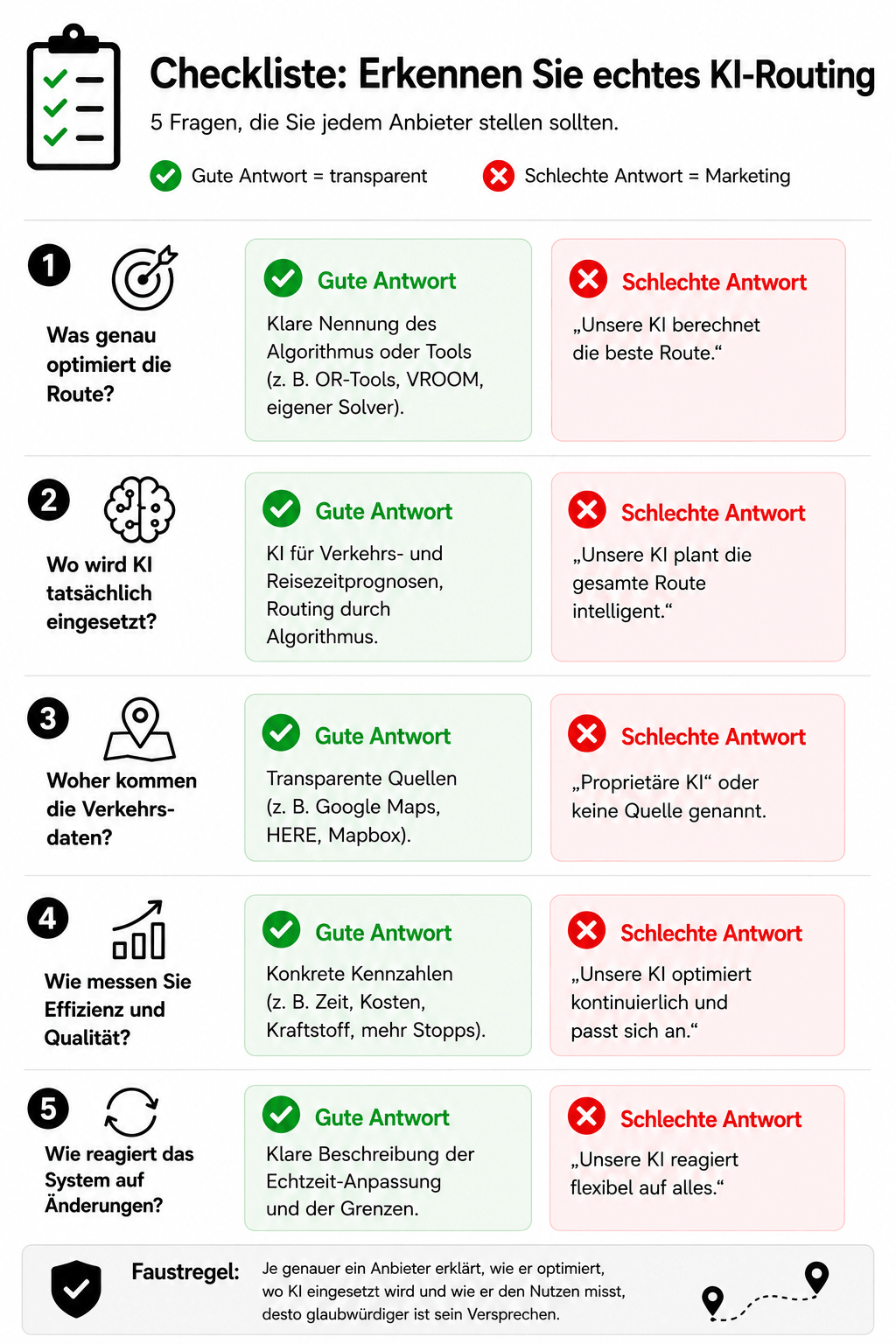
Turn the criticism into a test. Ask every vendor of "AI route planning" or an "intelligent trip planner" these questions.
What exactly optimizes the route?
Good answer: "We use OR-Tools, VROOM or a proprietary solver based on a named algorithm." That is honest, checkable and explainable.
Bad answer: "Our AI assistant calculates the best route." Without specifics that is a buzzword, not content.
Is a neural network involved in the routing decision, or only in the traffic and real-time estimates?
Good answer: "AI is in the travel-time forecasts and traffic. The routes are calculated by an optimization algorithm." Honest and correct.
Bad answer: "Our AI tool plans the entire route intelligently." That is either false or unverifiable.
Where does your real-time traffic data come from?
Good answer: "We use Google Maps Platform API, HERE or Mapbox." Transparent, and level 2.
Bad answer: evasion, vagueness, or "proprietary AI" without details.
How do you measure efficiency and route quality?
Good answer: concrete metrics — fuel saved, driving time reduced, lower route costs, more orders per route.
Bad answer: "Our AI optimizes continuously and adapts." Without measurement that means very little.
How does the system handle unforeseen events?
Good answer: a clear description of real-time adaptation for congestion, weather and last-minute changes, and of the system's limits.
Bad answer: "Our intelligent AI responds flexibly to everything." Without explanation, worthless.
What an honest "AI route planning" label would say
The economic consequences of misleading AI communication are concrete. Companies may pay a premium for a technological upgrade that in practice consists mainly of a new label. Instead of paying for measurable performance improvements, they pay for a promise that is not cleanly evidenced.
Longer term this damages the industry too. When "AI" is used indiscriminately, genuine advances in intelligent route planning lose credibility, and technologies that really do open up new possibilities risk being dismissed as hype as well.
A fair assessment matters here. The software behind many of these products is often powerful and proven in practice. Route optimization algorithms like OR-Tools and VROOM are mature tools that create real value in logistics every day. The problem is not necessarily the product; it is how it is marketed.
An honest label would read something like:
Route optimization based on proven algorithms, supplemented by AI-driven real-time traffic prediction. Efficient, automated and flexibly adjustable.
That would be precise, technically correct and still convincing.
What can you take from this? Ask the checklist questions. Demand concrete answers on algorithms, efficiency, data sources and measurable results. Do not accept vague statements like "our AI assistant" or "our intelligent tool" unless it is made clear which technology is actually behind them. Vendors who answer openly and precisely are the ones who deserve your trust and your budget.
Frequently asked questions
Is AI route planning really better than classical route planning?
No. At present essentially all vendors use the same underlying optimization algorithms, which have existed for decades. Some advertise misleadingly with "AI". The label does not make the software better. What matters is the algorithm behind it, not the marketing term in front of it.
Does Google Maps use AI for navigation?
Yes, but a different kind of AI from the one many vendors imply. Google Maps uses machine learning to predict traffic and arrival times. It does not plan routes with many stops. It mostly predicts how long a stretch of road will take.
Can ChatGPT plan routes?
Technically a language model can produce simple route suggestions. For professional route planning it is the wrong core tool. It does not calculate a mathematically optimized solution; it produces answers based on probabilities. As soon as several stops, vehicles and rules come into play, it lacks reliability, reproducibility and optimization quality. On top of that, API use incurs ongoing costs well beyond those of classical algorithms.
Is there AI that plans routes by itself, without classical algorithms?
Yes, but only in research. Neural networks and large language models are being actively tested for it. The current state according to peer-reviewed literature from 2026 is promising but not yet reliable enough for production use, particularly with larger fleets and many constraints.
Is the software still good even if it is not "real AI"?
Frequently, yes. The optimization algorithms behind these tools have been proven for decades and deliver very good results in practice. The problem is not the software; it is the misleading label.


Try xRouten free for 14 days
Try it now